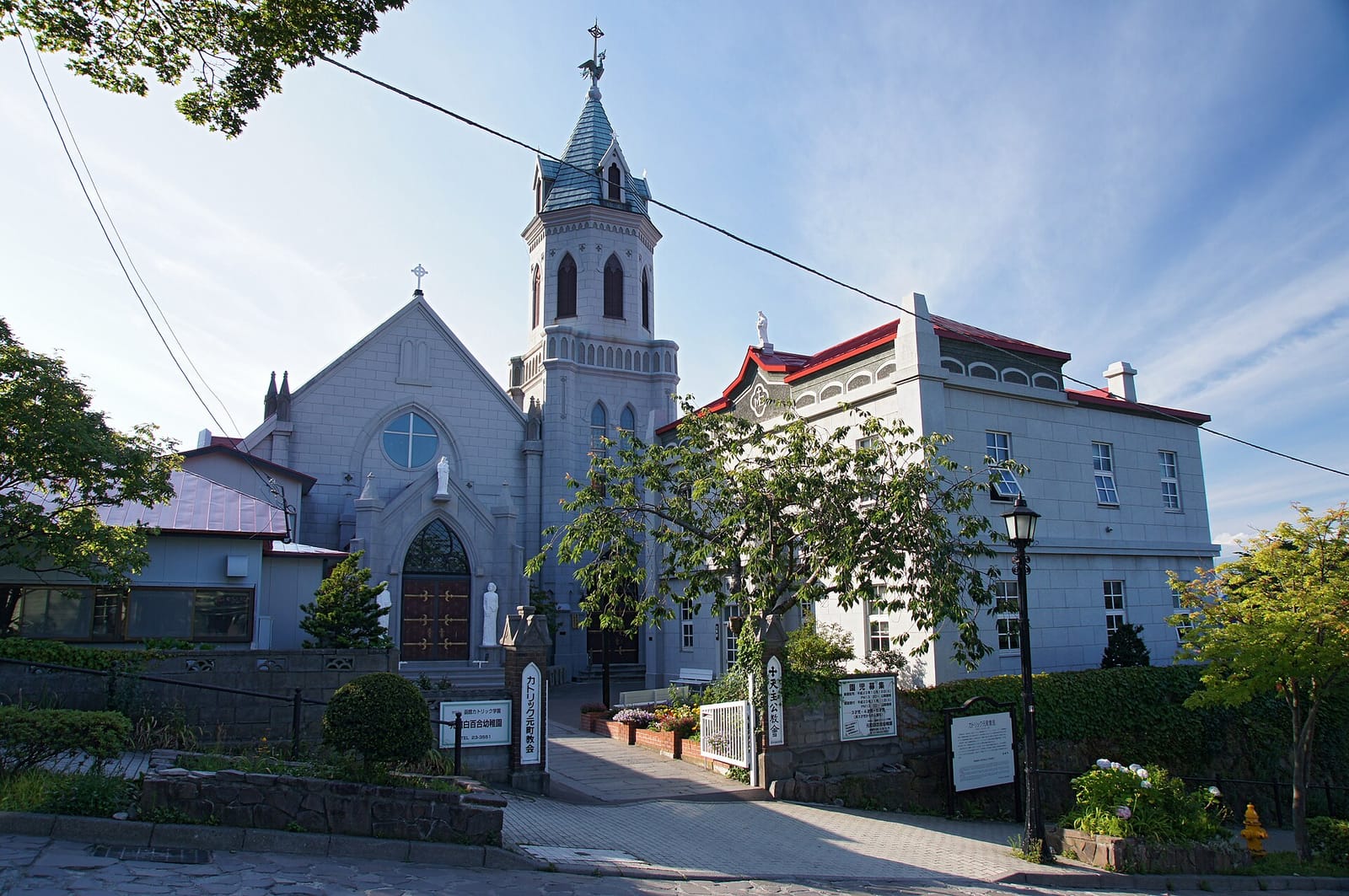
The Catholic church in Motomachi
Photo: 663highland / CC BY 2.5 · Original · Resized and croppedHistoric districts
Hakodate Motomachi and Suehiro-cho
函館市元町末広町 (はこだてしもとまちすえひろちょう)
On the slopes running from the foot of Mount Hakodate down to the harbor, Western-style churches and consulates from the port's opening stand alongside Japanese townhouses and the hybrid Japanese-Western houses unique to Hakodate. The city calls this port district the birthplace of Hakodate.
Key facts
- Designation
- Important Preservation Districts for Groups of Traditional Buildings
- Type
- Historic districts
- Location
- Hakodate, Hokkaido
- Address
- 北海道函館市
Before you go
- Opening hours
- The Old Public Hall of Hakodate Ward, the district's main sight, is open 9:00 to 18:00 from April to October (until 19:00 Saturday to Monday) and 9:00 to 17:00 from November to March.
- Closed
- The Old Public Hall of Hakodate Ward is closed over the New Year holidays (December 31 to January 3) and on occasional maintenance days.
- Admission (adults)
- Admission to the Old Public Hall of Hakodate Ward is ¥300 for adults.
- Time needed
- A walking route of about 1.5 km past the historic buildings takes about an hour on foot, or 2 to 3 hours including visits inside.
- Getting there
- From Hakodate Station, take tram route 5 (bound for Hakodate Dock-mae) to Suehiro-cho stop, then walk 7 minutes to the Old Public Hall of Hakodate Ward (about 16 minutes from the station). Or take a Hakodate Bus bound for Koryuji to Kokaido-mae bus stop and walk 3 minutes. Drivers can use the paid Motomachi Tourist Parking Lot (93 cars).
- Good to know
- The Motomachi Tourist Parking Lot costs ¥300 for the first hour and ¥150 per 30 minutes after that (the multi-story section is open 9:00 to 19:30 from April to October and 9:00 to 17:30 from November to March; the open-air section is open 24 hours). Private homes such as the Ishii residence can only be viewed quietly from the street.
Checked against official information on November 12, 2026. Fees and hours can change, so please also check the official site before you go.
Sources for visitor information
- City of Hakodate: Overview of the Motomachi-Suehirocho Preservation District
- City of Hakodate: Old Public Hall of Hakodate Ward
- City of Hakodate: Tourist parking
- Hakobura (Hakodate City official tourism site): Photo walk through Hakodate's historic buildings
- Hakobura (Hakodate City official tourism site): Ishii residence
Key facts
- Designation
- Important Preservation Districts for Groups of Traditional Buildings
- Type
- Historic districts
- Location
- Hakodate, Hokkaido
- Address
- 北海道函館市
About this place
Hakodate Motomachi and Suehiro-cho is a port-town preservation district of about 14.5 hectares, spread over the slope that runs down from the foot of Mt. Hakodate to the harbor. Hakodate opened in 1859 as one of Japan's first trading ports, and the redevelopment that followed a major fire in the Meiji period fixed the basic layout of today's district. It was selected as an Important Preservation District for Groups of Traditional Buildings in 1989. The city regards the area as the birthplace of Hakodate.
What defines the town is the mix of building types. Western-style buildings such as consulates and churches, Japanese-style townhouses, and hybrid Japanese-Western buildings survive, mostly from the Meiji, Taisho and early Showa periods. The city describes the hybrid style as peculiar to Hakodate, so rather than hunting only for Western houses, look for the places on the slope where Japanese and Western buildings stand side by side. That is where the town's character shows. This mix arose from the inflow of foreign cultures after the port opened.
Restored buildings also give you something to look for. The former Jinju Life Insurance Hakodate branch, built in 1921, was converted from offices into the commercial building Daisanzaka Building. The Hokusho Denki building, built in 1909, had its exterior restored to its original appearance and became the shop-and-residence Hakodate Kanesa Sasaki House. The city records that around the Kanemori Warehouses and the Hakodate Orthodox Church (Resurrection Cathedral), preserving and using traditional buildings has drawn people to the townscape.
Preservation proceeded in stages: a survey in fiscal 1982, designation of a preservation district by the city in 1988, national selection in 1989, and the founding in 1990 of a preservation society made up mainly of building owners. From fiscal 1989 to fiscal 2025, the cumulative total is 179 repair projects, 12 landscape-improvement projects and 15 restoration projects. The society keeps residents involved, for example by holding concerts in the Catholic Motomachi Church, itself a traditional building.
The Hakodate Machinami Museum, which opens part of the former Miura House (built in 1922), shows materials on preservation districts across Japan and a folding screen of photographs of the western district taken in 1882. If you stop there before walking, you can compare today's slopes with how they looked well over a century ago. Then, going on to the Kanemori Warehouses and the Orthodox Church area, you can see preservation and reuse progressing together within one district.
About the district
- Type of district
- port town
- Area
- 14.5 hectares
- Selected
- April 21, 1989
Sources and date checked
Facts such as eras, structures and locations are edited and translated by us from the Agency for Cultural Affairs’ database of nationally designated cultural properties. The Agency and the national government did not produce this page.
Database of nationally designated cultural properties- Agency for Cultural Affairs, Database of National Cultural Properties
- Hakodate City Motomachi-Suehirocho (Overview of the Important Preservation District for Groups of Traditional Buildings, prepared by Hakodate City, published by Agency for Cultural Affairs)
Checked on November 6, 2026
Report an error
If you notice a mistake, please tell us along with a source for the correct information.
Where to go next
Places you could see on the same day, and places worth comparing.
More from Hokkaido
Discover more of the same region on our sister sites.
Ikimono Kokuho
Natural Monument animals of Hokkaido
- Red-crowned Crane
- Freija Fritillary (Asahidake subspecies)
- Daisetsu Arctic Butterfly (Melissa Arctic)
- Grizzled Skipper (Hokkaido population)
Meiga no Furusato
Paintings linked to Hokkaido
- Ainu Banquet, Folding Screen
- Preparatory Drawings for Portraits of Ainu Chiefs (Ishu Retsuzo)
- Morning Prayer
- Orchestra
J-TRIP Portal
Sightseeing spots in Hokkaido
- Upopoy (National Ainu Museum and Park)
- Nemuro Peninsula Chashi Sites
- Kiroro Snow World
- Hakodate Morning Market