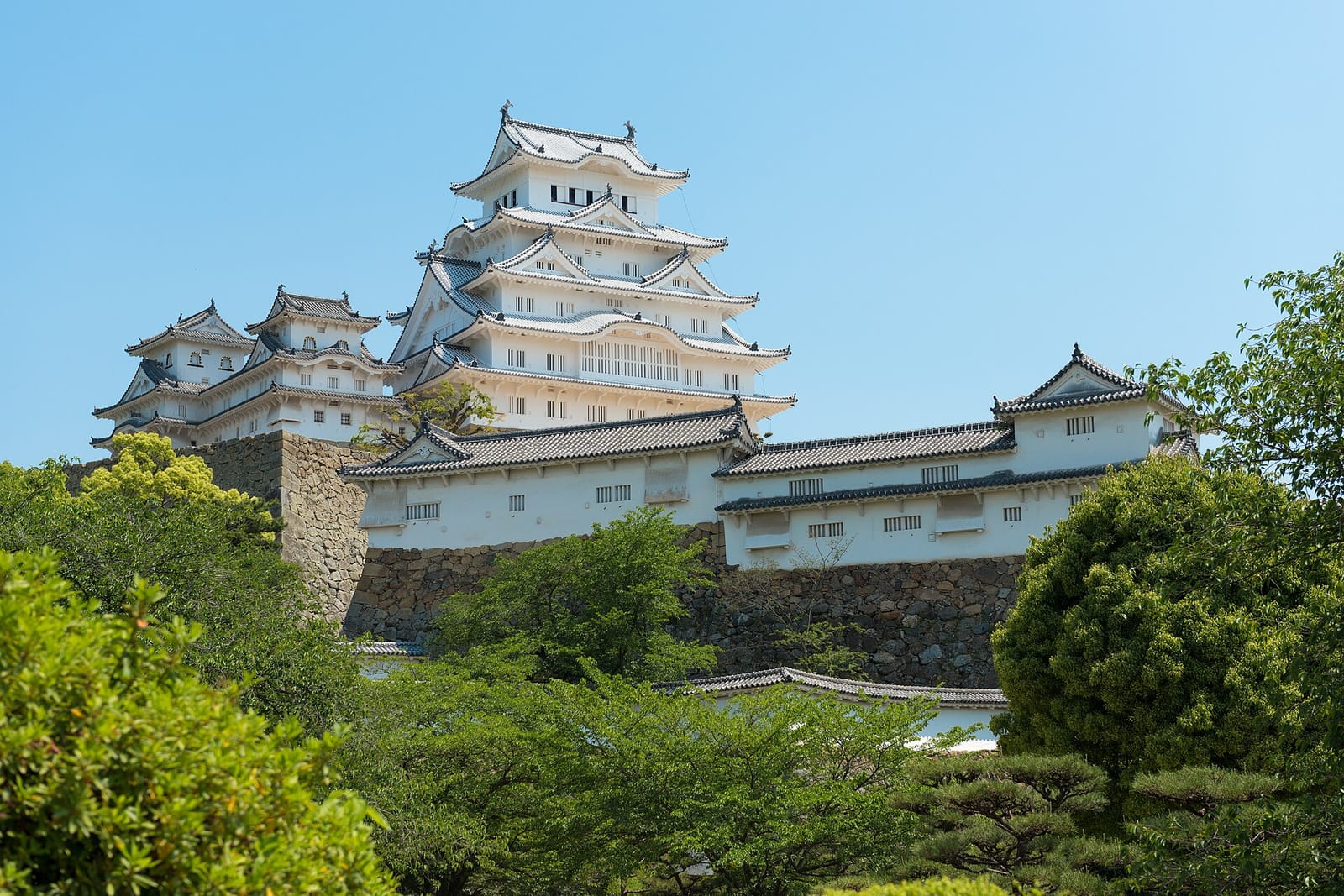
The main keep and smaller keeps
Photo: Nikos Kitsakis / CC BY-SA 4.0 · Original · Resized and croppedMomoyama period · Castles · National Treasures
Himeji Castle
姫路城 (ひめじじょう)
Himeji Castle keeps its early-Edo-period form: a white-plastered main keep linked by corridor turrets to three smaller keeps. In 1993 it became one of Japan's first World Heritage Sites, together with Horyu-ji.
Key facts
- Designation
- National Treasures
- Era
- Momoyama period
- Type
- Castles
- Location
- Himeji, Hyogo
- Address
- 兵庫県姫路市本町
Before you go
- Opening hours
- 9:00-17:00 (last entry 16:00). From 16:30, windows in the main keep, the Nishi-no-maru and the Hyakken Corridor are closed in turn.
- Closed
- December 29 and 30
- Admission (adults)
- Castle admission is ¥2,500 for adults (18 and over). A combined ticket with Koko-en Garden is ¥2,600. Under 18s enter free.
- Time needed
- Check the official site
- Getting there
- About a 20-minute walk from JR Himeji Station or Sanyo Himeji Station. Or take a Shinki Bus from the north exit of Himeji Station to Otemon-mae bus stop, then walk 5 minutes. Drivers can use the paid Otemon Parking Lot (about 555 cars; ¥600 for up to 3 hours, ¥900 per day beyond that; no reservations).
- Best time to visit
- Every night the castle is lit in white from sunset until midnight (the Saiun light-up), with 15-minute seasonal color shows starting at 20:00 and 21:00.
- Good to know
- Entry to the main keep is limited to 1,000 people per hour, so you may have to wait at the entrance on busy days. The timed Shirasagi digital ticket speeds up entry. From early July 2026 to around late July 2027, repair work around the main keep narrows parts of the route and affects the view and the light-up.
Checked against official information on November 12, 2026. Fees and hours can change, so please also check the official site before you go.
Sources for visitor information
Key facts
- Designation
- National Treasures
- Era
- Momoyama period
- Type
- Castles
- Location
- Himeji, Hyogo
- Address
- 兵庫県姫路市本町
About this place
Himeji Castle stands on a low hill called Himeyama. In the early Edo period Japan had roughly 180 castles of various sizes, but most were lost to the Meiji Restoration and to the Pacific War. Himeji came through repeated crises with its original form largely intact, and in 1993, together with Horyu-ji, it became the first World Cultural Heritage site in Japan. It is one of the five castles in the country whose keeps are designated National Treasures.
The National Treasure structures number eight: the Main Keep, the West, Inui (northwest) and East Small Keeps, and the four connecting corridor turrets. The Main Keep has five roofs on the outside and seven floors inside: six above ground and one basement level. With its small keeps it forms a complex keep. Inscriptions show it was built from 1608 into the following year. Each building differs in height and roof shape, so the group changes appearance depending on the angle from which you see it.
The site's history goes back to the 14th century. Akamatsu Norimura built a fort on Himeyama in 1333, and Akamatsu Sadanori built a proper castle in 1346. In 1580 Kuroda Yoshitaka presented the castle to Hashiba Hideyoshi, who built a three-story keep. After the Battle of Sekigahara, Ikeda Terumasa became lord in 1600, began a major reconstruction the next year, and in 1609 completed the linked keep complex: the seven-floor Main Keep (counting the basement) joined to three small keeps by corridor turrets. The keeps standing today date from the Ikeda era. When Honda Tadamasa entered the castle in 1617, the Third Bailey and the West Bailey were added.
Modern repair work explains why the castle looks as it does. In June 1934 heavy rain brought down a corridor turret of the West Bailey together with its stone wall, which started the great repair campaign. Dismantling and repair of the Main Keep began in 1956, and many inscriptions found during the work revealed how the keep was built. The work finished in 1964 after eight years and some 250,000 person-days of labor. A conservation project on the Main Keep began in 2009, and the castle held its grand reopening in 2015.
It helps to understand how the whole castle was laid out before you walk it, rather than only climbing the keep. Legend ties the Okiku Well to the tale of the Banshu Plate Mansion, and tells of the master builder Sakurai Genbei, said to have thrown himself to his death after the keep was pointed out as leaning. The official site notes, however, that the actual lean was confirmed to come from the settling of the stone walls on the east and southeast corners. Around the castle, the official site introduces places such as Senhime-no-Komichi, the Senhime Peony Garden, Harima Kuni Soja and Otokoyama Hachimangu, which can be combined with a castle visit.
Buildings designated as National Treasures
Himeji Castle Main Keep
- Era
- Momoyama period
- Year
- 1608
- Structure
- five-tiered, six stories, with one basement floor, tiled roofing (honkawara-buki)
- Designated
- June 9, 1951
Himeji Castle West Small Keep
- Era
- Momoyama period
- Year
- 1609
- Structure
- three-tiered, three stories, with two basement floors, tiled roofing (honkawara-buki)
- Designated
- June 9, 1951
Himeji Castle Inui Small Keep
- Era
- Momoyama period
- Year
- 1609
- Structure
- three-tiered, four stories, with one basement floor, tiled roofing (honkawara-buki)
- Designated
- June 9, 1951
Himeji Castle East Small Keep
- Era
- Momoyama period
- Structure
- three-tiered, three stories, with one basement floor, tiled roofing (honkawara-buki)
- Designated
- June 9, 1951
Himeji Castle I Connecting Turret
- Era
- Momoyama period
- Structure
- two-tiered, two stories, with one basement floor, tiled roofing (honkawara-buki)
- Designated
- June 9, 1951
Himeji Castle Ro Connecting Turret
- Era
- Momoyama period
- Structure
- two-tiered, two stories, with one basement floor, tiled roofing (honkawara-buki)
- Designated
- June 9, 1951
Himeji Castle Ha Connecting Turret
- Era
- Momoyama period
- Structure
- two-tiered, two stories, with one basement floor, tiled roofing (honkawara-buki)
- Designated
- June 9, 1951
Himeji Castle Ni Connecting Turret
- Era
- Momoyama period
- Structure
- two-story turret gate (yaguramon), tiled roofing (honkawara-buki)
- Designated
- June 9, 1951
Sources and date checked
Facts such as eras, structures and locations are edited and translated by us from the Agency for Cultural Affairs’ database of nationally designated cultural properties. The Agency and the national government did not produce this page.
Database of nationally designated cultural properties- Agency for Cultural Affairs, Database of National Cultural Properties: Himeji Castle Main Keep
- Agency for Cultural Affairs, Database of National Cultural Properties: Himeji Castle West Small Keep
- Agency for Cultural Affairs, Database of National Cultural Properties: Himeji Castle Inui Small Keep
- Agency for Cultural Affairs, Database of National Cultural Properties: Himeji Castle East Small Keep
- Agency for Cultural Affairs, Database of National Cultural Properties: Himeji Castle I Connecting Turret
- Agency for Cultural Affairs, Database of National Cultural Properties: Himeji Castle Ro Connecting Turret
- Agency for Cultural Affairs, Database of National Cultural Properties: Himeji Castle Ha Connecting Turret
- Agency for Cultural Affairs, Database of National Cultural Properties: Himeji Castle Ni Connecting Turret
- Himeji Castle: History (Himeji City)
- Himeji Castle: History (Great Showa Restoration) (Himeji City)
- World Cultural Heritage: Himeji Castle (Himeji City)
- Castle Guide (Himeji City)
- World Cultural Heritage, National Treasure: Himeji Castle (Himeji City)
Checked on November 6, 2026
Report an error
If you notice a mistake, please tell us along with a source for the correct information.
Where to go next
Places you could see on the same day, and places worth comparing.
More from Hyogo
Discover more of the same region on our sister sites.
Meiga no Furusato
Paintings linked to Hyogo
- Famous Places in the Sixty-odd Provinces: Tanba Province: Kane Slope
- Famous Places in the Sixty-odd Provinces: Tajima Province: The Cave Kannon in Iwai Valley
- Famous Places in the Sixty-odd Provinces: Harima Province: Maiko Beach
- Famous Places in the Sixty-odd Provinces: Awaji Province: Goshiki Beach
Sake Tabi
Breweries and distilleries in Hyogo
- Eigashima Shuzo (sake brewery and whisky distillery tour)
- Hakutsuru Sake Brewery Museum
- Kiku-Masamune Sake Brewery Museum (Xross SAKE PALE ALE)
- Kikumasamune Sake Museum