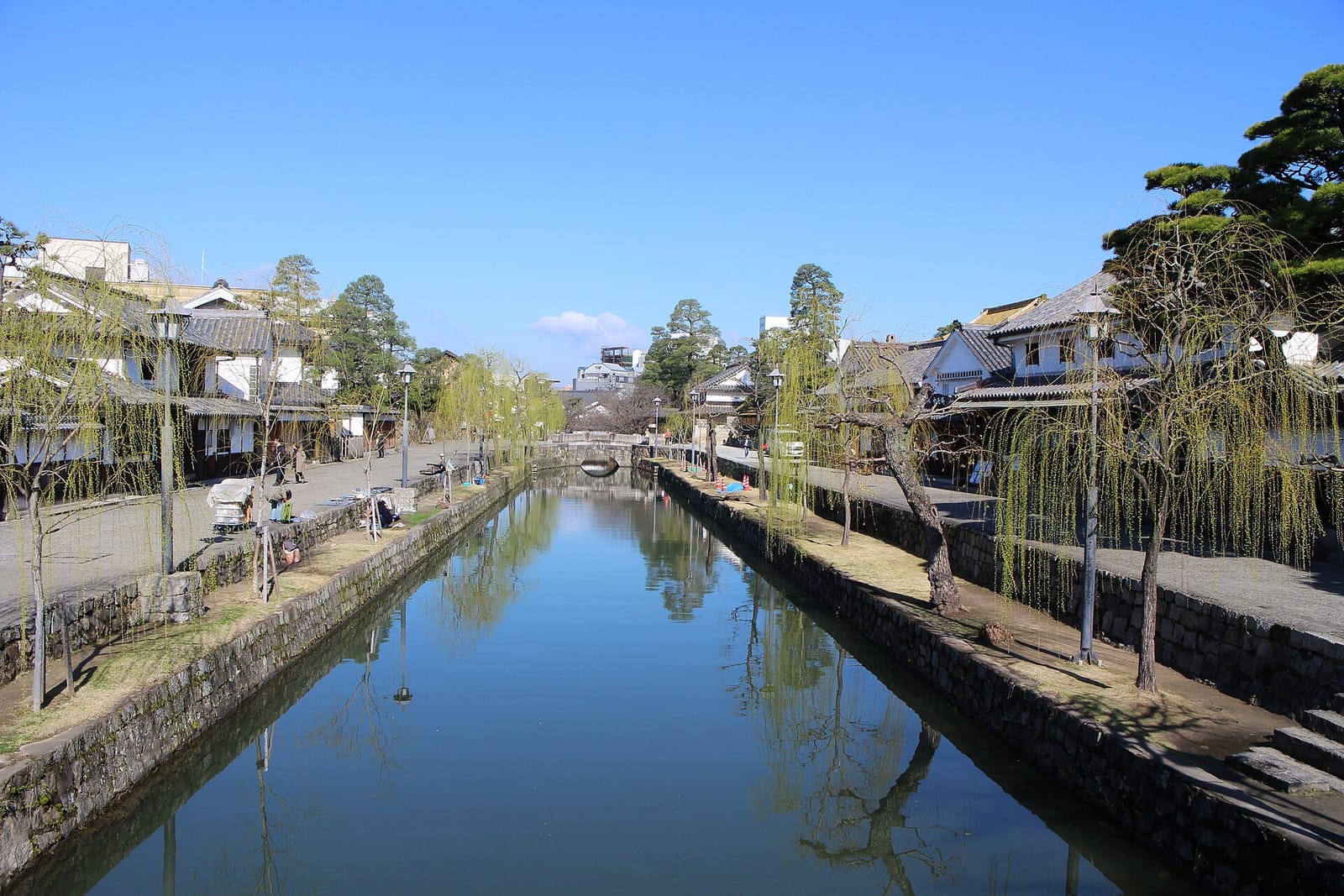
The Kurashiki River and its townscape
Photo: Suicasmo / CC BY-SA 4.0 · Original · Resized and croppedHistoric districts
Kurashiki Kawahan (Bikan Historical Quarter)
倉敷市倉敷川畔 (くらしきしくらしきかわはん)
Along the Kurashiki River, white-walled merchant houses and storehouses recall the prosperity of a port town that served as a shogunate-controlled distribution hub. Compare details like namako tile walls and heavy tiled roofs, then enjoy a river boat ride or the evening illumination.
Key facts
- Designation
- Important Preservation Districts for Groups of Traditional Buildings
- Type
- Historic districts
- Location
- Kurashiki, Okayama
- Address
- 岡山県倉敷市
Before you go
- Opening hours
- Check the official site
- Closed
- Check the official site
- Admission (adults)
- The Kurashiki river boat ride costs ¥1,000 for adults and ¥500 for children (free for those under 5).
- Time needed
- Allow about 1–2 hours just to stroll the streets.
- Getting there
- The district is about 13 min on foot from JR Kurashiki Station, or about 5 min by bus (Kurashiki Station is about 17 min from Okayama Station on the JR Sanyo Line). Drivers should use paid lots nearby, such as the city-run Bikan Chiku Higashi parking lot.
- Best time to visit
- The area around the Kurashiki River and Kurashiki Ivy Square is illuminated from sunset to 22:00 (until 21:00 from October to March). The Kurashiki Haruyoi Akari light festival is held every March.
- Good to know
- Streets in the district are narrow and crowded with pedestrians, so avoid driving in; the road along the Kurashiki River is closed to vehicles at certain times. Do not park in nearby shops' lots. The city's Chuo and Bikan Chiku Minami lots get very crowded on weekends and holidays, so the Bikan Chiku Higashi lot and others are recommended.
Checked against official information on November 12, 2026. Fees and hours can change, so please also check the official site before you go.
Sources for visitor information
Key facts
- Designation
- Important Preservation Districts for Groups of Traditional Buildings
- Type
- Historic districts
- Location
- Kurashiki, Okayama
- Address
- 岡山県倉敷市
About this place
Kurashiki Kawahan is a merchant town centered on the Kurashiki River in Kurashiki, Okayama Prefecture. It was selected as an Important Preservation District for Groups of Traditional Buildings on 21 May 1979. It lies at the southern foot of Tsurugata-yama (36.8 meters above sea level), and the district now covers 15.0 hectares. It is known for its riverside views, but the town's origin lies less in the waterside scenery than in the economy of a port where goods gathered.
The turning point came in 1642 (Kan'ei 19), when Kurashiki became shogunate land. As it worked as a commercial port where tribute rice and farm products came in and went out, merchants who had made their fortunes from the town's prosperity gained power. In time the town came to be lined mainly with honkawara-buki nuriya-zukuri townhouses and storehouses (kura). The rows of white walls and tiles seen today are not scenery made for tourism but an expression of the wealth the merchants stored up.
According to the National Council of Traditional Building Preservation Districts, the buildings are notable for the many tsushi-nikai (low-ceilinged second-floor) houses, and for main houses and storehouses roofed with honkawara tiles. Tiles are not limited to the main roofs: on the nuriya-zukuri (plastered) buildings they are often applied over the eave roofs and elsewhere. Some storehouses combine namako-kabe walls with mizukiri-bisashi drip eaves, and the tall walls are capped with tile as well. If you notice the differences by material and part, namako-kabe walls, drip eaves and honkawara roofs, you will see that even white walls are each built differently. The Council says these buildings harmonize to create a distinctive landscape that feels bright within its weightiness.
In the history of preservation, after the merger of Kurashiki, Kojima and Tamashima in 1967, the Kurashiki Traditional Beauty Preservation Ordinance was promulgated in 1968. A survey followed in 1973, a preservation ordinance was enacted in 1978, and the district became a national district in 1979. In 1998 the area was expanded from 13.5 to 15.0 hectares. In 1999 a 21.0-hectare Bikan district, combining the 15.0-hectare preservation district with a surrounding 6.0-hectare traditional beauty zone, was fixed in the city plan. Night lighting, produced by the lighting designer Motoko Ishii, began in 2005 and was completed in 2009. The burying of utility lines was completed in 2013.
The chairperson of a local preservation group says that before the designation Kurashiki had a fish market and ironworks and felt more lived-in than it does now. Among residents' efforts, the Kurashiki Machiya Trust and a group to protect and nurture the preservation district were both founded in 2006. In restoring the Honmachi Misaka house, the trust repaired structural members with old timber wherever possible, with help from many volunteers. Events include the Setouchi no Hanayome river boat procession in May and the Kurashiki Byobu Matsuri in October. To read the town, walk with attention to how the southern foot of Tsurugata-yama relates to the river and how the buildings line it; the structure of a town developed as a port becomes easier to understand.
About the district
- Type of district
- merchant town
- Area
- 15 hectares
- Selected
- May 21, 1979
Sources and date checked
Facts such as eras, structures and locations are edited and translated by us from the Agency for Cultural Affairs’ database of nationally designated cultural properties. The Agency and the national government did not produce this page.
Database of nationally designated cultural properties- Agency for Cultural Affairs, Database of National Cultural Properties
- Kurashiki City Kurashiki-gawahan (Agency for Cultural Affairs, Preservation and Utilization of Important Preservation Districts for Groups of Traditional Buildings, document by Kurashiki City)
- National Council for Preservation of Historic Districts: Kurashiki City Kurashiki-gawahan
Checked on November 6, 2026
Report an error
If you notice a mistake, please tell us along with a source for the correct information.
Where to go next
Places you could see on the same day, and places worth comparing.
More from Okayama
Discover more of the same region on our sister sites.
Meiga no Furusato
Paintings linked to Okayama
- Famous Places in the Sixty-odd Provinces: Mimasaka Province: Yamabushi Valley
- Famous Places in the Sixty-odd Provinces: Bizen Province: The Torii of Yugasan near the Beach of Tanokuchi
- Famous Places in the Sixty-odd Provinces: Bitchu Province: Gokei Gorge
- The Annunciation