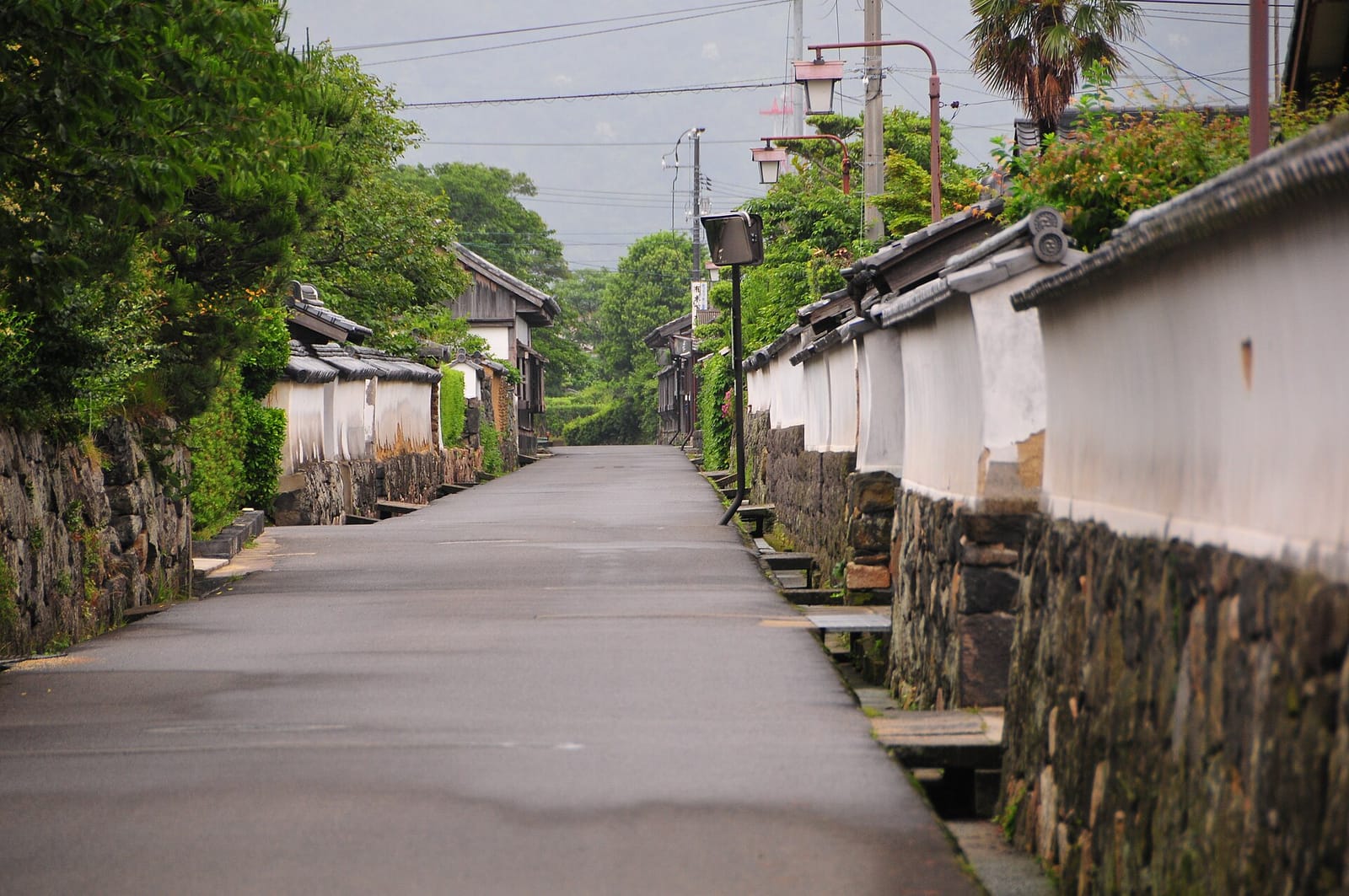
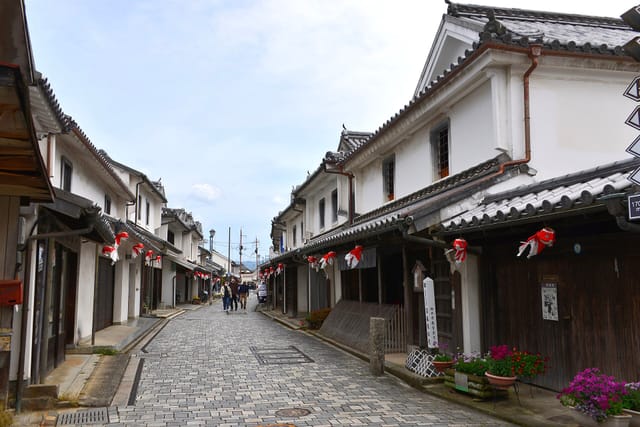
An earthen-walled street in Horiuchi
Photo: Isoyan / CC BY-SA 3.0 · Original · Resized and croppedHistoric districts
Horiuchi District, Hagi
萩市堀内地区 (はぎしほりうちちく)
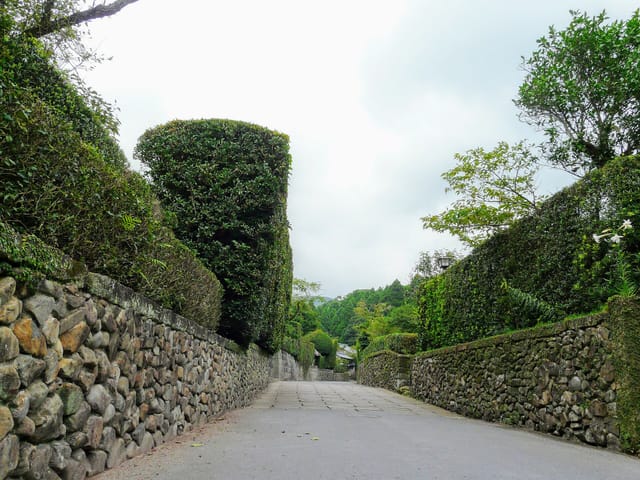
Horiuchi, the former third enclosure of Hagi Castle, is a samurai district where the Hagi domain's offices and the mansions of senior retainers once stood. Streets lined with heavy earthen walls and stone walls, with summer oranges peeking over the top, create a scene typical of Hagi.
Key facts
- Designation
- Important Preservation Districts for Groups of Traditional Buildings
- Type
- Historic districts
- Location
- Hagi, Yamaguchi
- Address
- 山口県萩市
Before you go
- Opening hours
- Check the official site
- Closed
- The Kuchiba Residence, open to visitors within the district, is closed on Wednesdays.
- Admission (adults)
- Admission to the Kuchiba Residence is ¥100.
- Time needed
- Hagi City's old-map guided walk, which starts and ends at the Hagi Museum and loops through the Horiuchi district, takes about 2 hours.
- Getting there
- Get off at the Hagi Hakubutsukan-mae stop on the Hagi Ma-ru Bus Eastern Route; the district is right there. Drivers can use the Hagi Museum parking lot (¥310 per visit).
- Best time to visit
- On May 3, the Horiuchi Stroll is held, where local residents guide visitors around the castle town.
- Good to know
- Park at the Hagi Museum lot (¥310 per visit) and explore on foot. The Kuchiba Residence is closed on Wednesdays, so plan your day accordingly.
Checked against official information on November 12, 2026. Fees and hours can change, so please also check the official site before you go.
Sources for visitor information
Key facts
- Designation
- Important Preservation Districts for Groups of Traditional Buildings
- Type
- Historic districts
- Location
- Hagi, Yamaguchi
- Address
- 山口県萩市
About this place
The Horiuchi District of Hagi is a samurai quarter occupying the third enclosure of the former Hagi Castle. The history of the castle town goes back to 1608 (Keicho 13), when Mori Terumoto built his castle on Mt. Shizuki and divided up the town. The preservation district covers almost all of Horiuchi, about 55 hectares. In 1976 it was selected as an Important Preservation District for Groups of Traditional Buildings, together with the neighboring Hiyako District. Walking the streets of Horiuchi means tracing the framework of the castle town itself.
The area once held the domain's government offices (the domain storehouse office, the timber office, the office handling business for the domain's districts, the kitchen office and the foot soldiers' office) and the large residences of senior retainers, including relatives of the Mori clan. In other words, Horiuchi was closer to the center of the domain's government than to an ordinary residential area. The land division of a samurai quarter in an early modern castle town remains well preserved. That government offices and senior retainers' residences shared one district defines Horiuchi's character.
What is worth checking on foot is less each individual building than the way the earthen-walled streets are laid out. Summer orange trees rising above the earthen walls create the historic atmosphere of the district. Over ten samurai residences survive here, beginning with the lookout turret of the Masuda family, hereditary chief retainers. The turret offers a clue to how large the residences of the domain's senior retainers were.
The neighboring Hiyako District lies south of the outer moat that surrounds the third enclosure. While many senior retainers lived in Horiuchi, in Hiyako a large number of samurai set up residences as land clearing advanced. Along the Hashimoto River the Edo-period land division remains, and main houses, gate-houses (nagayamon), long houses and storehouses survive along with the long earthen walls that form the kaimagari (right-angle bends). If you look at the large residence plots in Horiuchi and then walk the kaimagari in Hiyako, the difference in how the two districts came about becomes visible.
The history of preservation also helps in reading the place. Hagi enacted an ordinance on the preservation of historic scenery in 1972, and in 1976 it enacted a preservation-district ordinance and received national selection. In 2004 it set out the duties of the city and its citizens in the Hagi Machijuu Museum Ordinance, and in 2015 the Horiuchi district was included in the component site "Hagi Castle Town (upper-class samurai quarter)" of the World Heritage property Sites of Japan's Meiji Industrial Revolution. Residents' clean-up activities, guided tours with old maps in Horiuchi, and the Natsumikan Festival in Hiyako continue today.
About the district
- Type of district
- samurai district
- Area
- 55 hectares
- Selected
- September 4, 1976
Sources and date checked
Facts such as eras, structures and locations are edited and translated by us from the Agency for Cultural Affairs’ database of nationally designated cultural properties. The Agency and the national government did not produce this page.
Database of nationally designated cultural properties- Agency for Cultural Affairs, Database of National Cultural Properties
- Hagi City Horiuchi and Heiankoza Districts (prepared by Hagi City, published by Agency for Cultural Affairs)
- National Council for Preservation of Historic Districts: Horiuchi District
Checked on November 6, 2026
Report an error
If you notice a mistake, please tell us along with a source for the correct information.
Where to go next
Places you could see on the same day, and places worth comparing.
Nearby cultural heritage
Places within 10 km, nearest first. Distances are in a straight line.
More from Yamaguchi
Discover more of the same region on our sister sites.
Meiga no Furusato
Paintings linked to Yamaguchi
- Famous Places in the Sixty-odd Provinces: Suo Province: The Kintai Bridge at Iwakuni
- Famous Places in the Sixty-odd Provinces: Nagato Province: Shimonoseki
Sake Tabi
Breweries and distilleries in Yamaguchi
- Dassai Head Brewery (DASSAI Inc.)
- Sakai Shuzo (Gokyo) Brewery Tour
- Nagayama Honke Shuzojo (Taka)
- Okazaki Shuzojo (Chomonkyo)