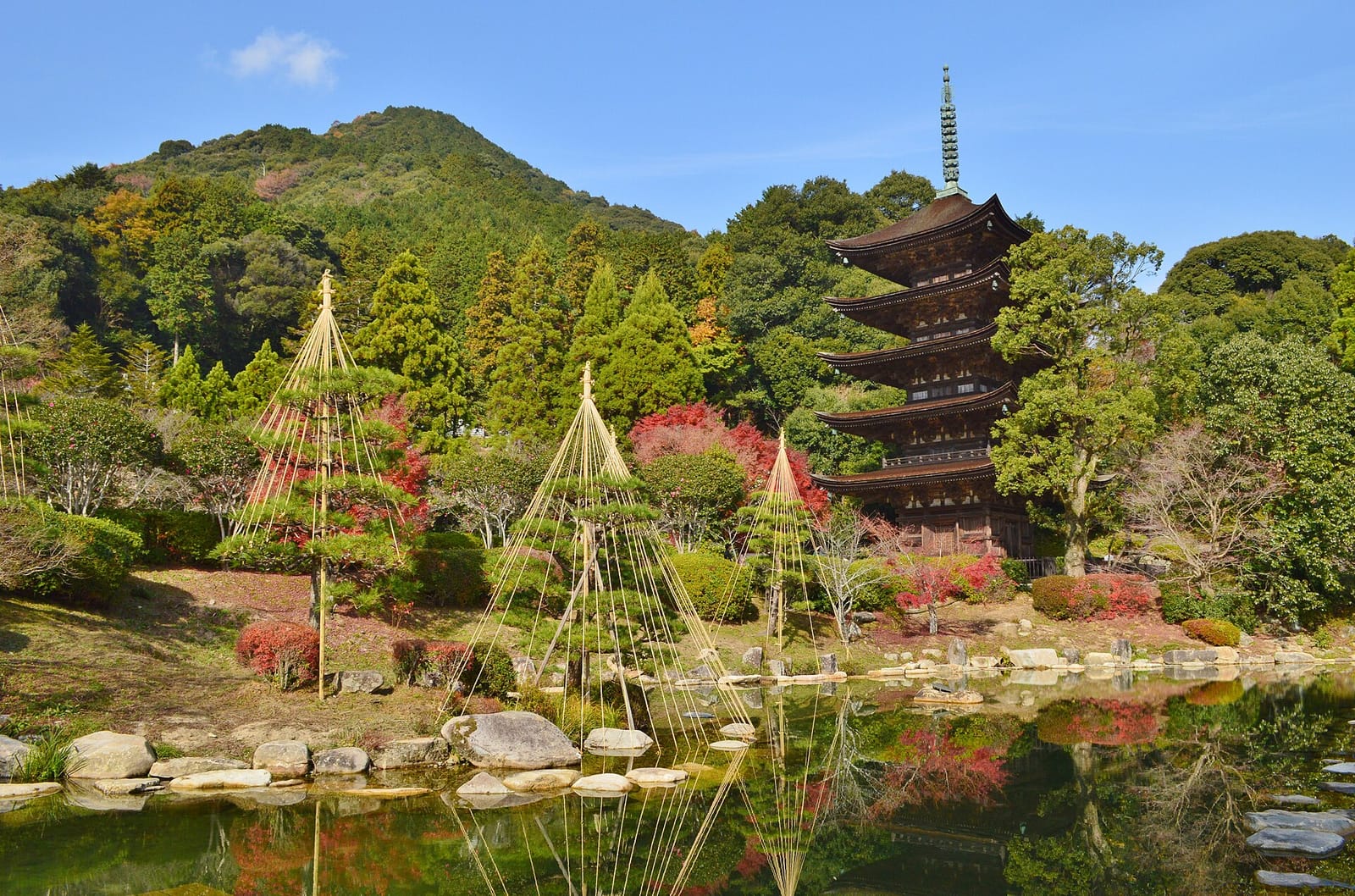
The five-story pagoda
Photo: Saigen Jiro / CC0 · Original · Resized and croppedMuromachi period · Temples · National Treasures
Rurikoji
瑠璃光寺 (るりこうじ)
Built at the height of the Ouchi clan's power, the Rurikoji Five-Story Pagoda is a National Treasure counted among Japan's three finest pagodas, alongside those of Horyu-ji and Daigo-ji. Its cypress-bark roofs reflect in the pond, changing with cherry blossoms, autumn leaves and evening illumination.
Key facts
- Designation
- National Treasures
- Era
- Muromachi period
- Type
- Temples
- Location
- Yamaguchi, Yamaguchi
- Address
- 山口県山口市香山町
Before you go
- Opening hours
- Kozan Park is open 24 hours. The Rurikoji Museum is open 9:00–17:00.
- Closed
- Open every day.
- Admission (adults)
- Free (Kozan Park and the pagoda). The Rurikoji Museum costs ¥200 for adults.
- Time needed
- Allow about 30 min around the pagoda, or about 1 hr 30 min for the whole of Kozan Park.
- Getting there
- From JR Yamaguchi Station, take the city community bus (Ouchi Route bound for Kozan Park, stop 4) for about 15 min to Kozan Koen Gojunoto-mae. It is about 25 min on foot from the station. Kozan Park has free parking, and on busy weekends, holidays and New Year, the Yamaguchi Prefectural Office lot (about 15 min walk) is also available.
- Best time to visit
- The pagoda is lit up from sunset to 22:00 all year round. Plum blossoms peak from early February to early March and about 170 cherry trees in late March, and in autumn the red leaves are reflected in the pond.
Checked against official information on November 12, 2026. Fees and hours can change, so please also check the official site before you go.
Sources for visitor information
- Yamaguchi City tourism site: Kozan Park and Rurikoji Pagoda
- Yamaguchi City tourism site: Kozan Park
- Yamaguchi City tourism site: Rurikoji Museum
- Yamaguchi City tourism site: Getting around from Yamaguchi Station
- Yamaguchi Prefectural Tourism Federation: Rurikoji Pagoda
- Yamaguchi City: Parking at Kozan Park
Key facts
- Designation
- National Treasures
- Era
- Muromachi period
- Type
- Temples
- Location
- Yamaguchi, Yamaguchi
- Address
- 山口県山口市香山町
About this place
The five-story pagoda of Rurikoji is said to have been planned by Ouchi Moriharu to honor his elder brother Ouchi Yoshihiro, who died in the Oei Rebellion of 1399. It is a remnant of Koshakuji, Yoshihiro's family temple, and is thought to have been completed in the second year of Kakitsu, around 1442. An ink inscription reading Kakitsu 2 was found on a bracket block during the dismantling repair of 1915 (Taisho 4), which is the basis for the date. The pagoda conveys the culture of the Ouchi clan at the height of its power in western Japan. It is a three-bay five-story pagoda and was designated a National Treasure in 1952.
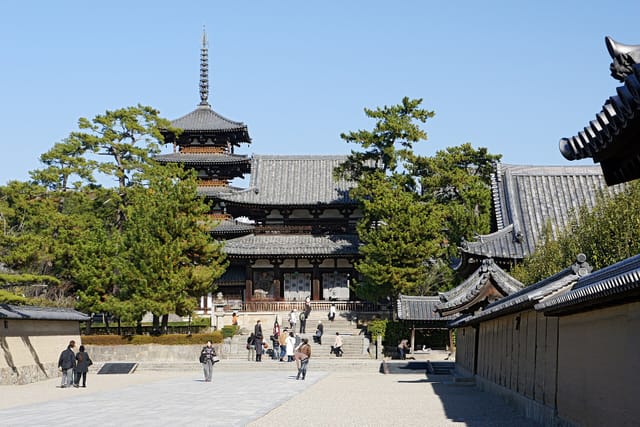
The style is basically Japanese (wayo), with a few Chinese-style (karayo) techniques. The roof is cypress-bark, and because the body of the tower narrows toward the top, the whole gives a clean impression. It is 31.2 meters tall, built with a central-pillar technique said to give high earthquake resistance, and is the tenth oldest surviving five-story pagoda. Along with Horyu-ji in Nara and Daigo-ji in Kyoto, it is counted among the Three Famous Pagodas of Japan. Up close, the overlapping roofs and the details of the timber stand out; from a little farther away, the whole shape is wrapped in the surrounding greenery.
The grounds of Rurikoji, where the pagoda stands, are part of Kozan Park. A pond lies before the tower, and the hill behind and the pagoda are reflected on its surface. In spring about 170 cherry trees harmonize with the pagoda, and the scene changes with fresh green in summer, autumn leaves, and snow in winter. It is lit from sunset until 22:00, showing a different face than by day. The great Reiwa-era restoration replaced the cypress-bark roof for the first time in about 70 years and was completed at the end of December 2025. The scaffolding roof has been removed, so the whole can again be seen up close. Kozan Park is free to enter, so it is easy to stop by on a stroll.
Nearby, the Rurikoji museum on the grounds shows the oldest surviving copy of Dogen's Shobogenzo in Japan and a model of the pagoda's framework. Close by are Toshunji, the family temple of Mori Motonari, and Chinryutei, where loyalists from Satsuma and Choshu gathered at the end of the Edo period. About 1.8 km away, Joeiji has a garden said to have been made by Sesshu. Yamaguchi is a town the Ouchi developed with Kyoto in mind, and walking around from the pagoda lets that history overlap with what you see. Because it is also a place of worship, visit quietly so as not to disturb worshippers.
Buildings designated as National Treasures
Rurikoji Five-Story Pagoda
- Era
- Mid-Muromachi period
- Year
- 1442
- Structure
- Three-bay, five-story pagoda, cypress-bark roofing
- Designated
- November 22, 1952
Sources and date checked
Facts such as eras, structures and locations are edited and translated by us from the Agency for Cultural Affairs’ database of nationally designated cultural properties. The Agency and the national government did not produce this page.
Database of nationally designated cultural properties- Agency for Cultural Affairs, Database of National Cultural Properties: Rurikoji Five-Story Pagoda
- Kotobank: Rurikoji Five-Story Pagoda
- JEEPE: Kozan Park
- GLT: National Treasure Rurikoji Five-Story Pagoda
Checked on November 6, 2026
Report an error
If you notice a mistake, please tell us along with a source for the correct information.
Where to go next
Places you could see on the same day, and places worth comparing.
More from Yamaguchi
Discover more of the same region on our sister sites.
Meiga no Furusato
Paintings linked to Yamaguchi
- Famous Places in the Sixty-odd Provinces: Suo Province: The Kintai Bridge at Iwakuni
- Famous Places in the Sixty-odd Provinces: Nagato Province: Shimonoseki
Sake Tabi
Breweries and distilleries in Yamaguchi
- Dassai Head Brewery (DASSAI Inc.)
- Sakai Shuzo (Gokyo) Brewery Tour
- Nagayama Honke Shuzojo (Taka)
- Okazaki Shuzojo (Chomonkyo)