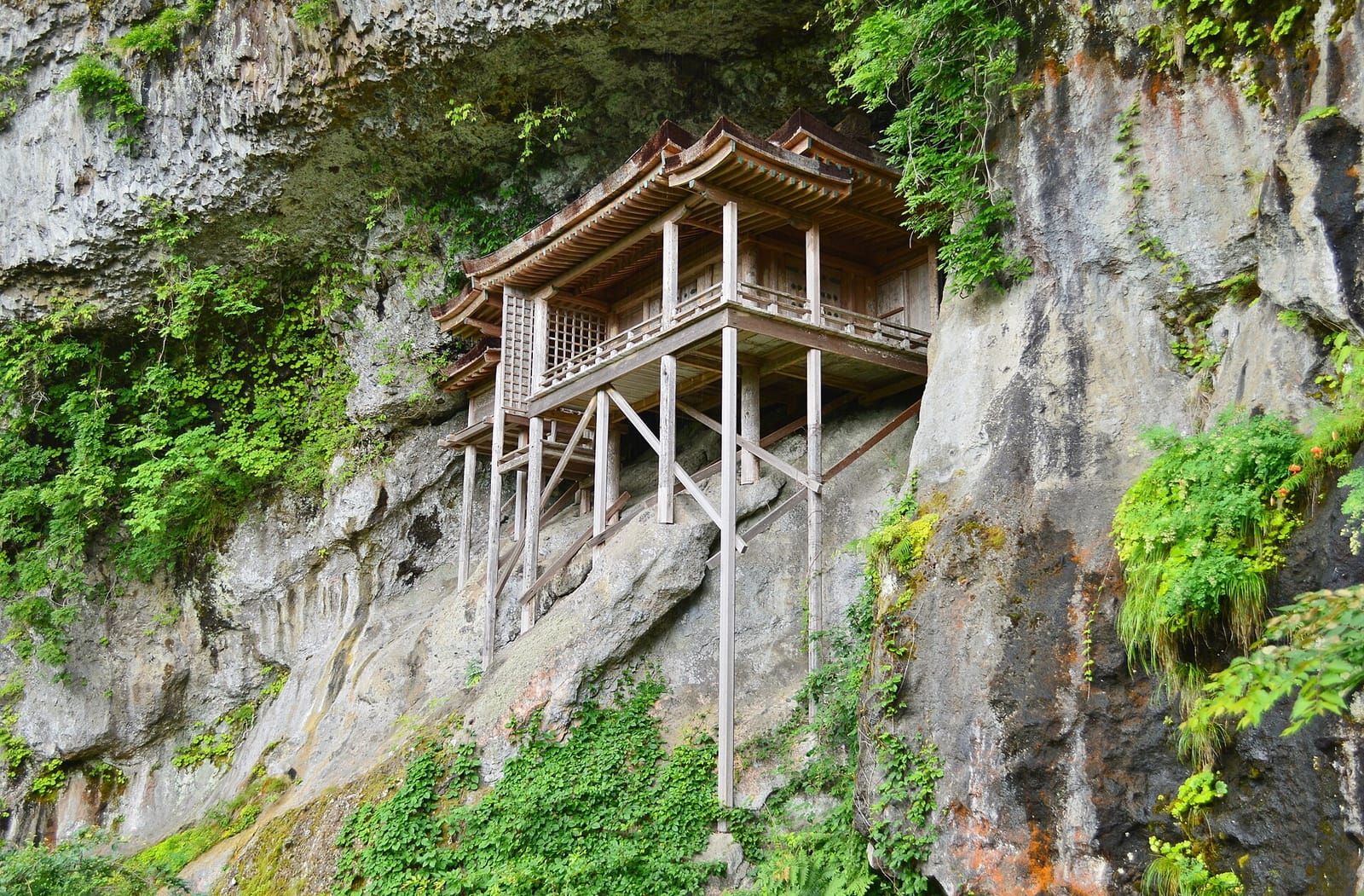
Sanbutsu-ji (Nageire-do)
Photo: Saigen Jiro / CC0 · Original · Resized and croppedHeian period · Temples · National Treasures
Sanbutsu-ji (Nageire-do)
三仏寺(投入堂) (さんぶつじ)
At Sanbutsu-ji you can see Nageire-do, a late-Heian hall built on long pillars in a hollow of a cliff on Mt. Mitoku, by making the pilgrimage climb up the ascetics' trail. Climbers must go in groups of two or more, and clothing and footwear are checked at the entrance.
Key facts
- Designation
- National Treasures
- Era
- Heian period
- Type
- Temples
- Location
- Misasa, Tottori
- Address
- 鳥取県東伯郡三朝町大字三徳
Before you go
- Opening hours
- Registration for the climb to Nageire-do is 8:00 to 15:00, and climbers must be back down by 16:30; the gate is closed outside these hours. The main hall can be visited 8:00 to 17:00.
- Closed
- The mountain is closed on days the temple judges unsafe because of rain or snow, and it is usually closed from about December to March because of snow. Whether the climb is open that day is posted at the top of the official website.
- Admission (adults)
- The mountain entry donation (up to the main hall, including the treasure hall) is 400 yen for adults. The climb to Nageire-do costs a further 800 yen, 1,200 yen in total.
- Time needed
- Check the official site
- Getting there
- From JR Kurayoshi Station, take a Hinomaru route bus via Misasa Onsen to the last stop, Mitokusan Parking (about 35 minutes). Some buses end at Misasa Depot, so check the destination on the timetable. By car it is about 10 minutes (about 7 km) from Misasa Onsen.
- Best time to visit
- The mountain opens for the season on April 1. At the summer service on July 18 the standing statue of Zao Gongen is shown to the public, and the autumn service on the last Sunday of October features an outdoor fire ritual and fire-walking.
- Good to know
- The climb must be made in a group of two or more, and clothing and footwear are checked at the entrance. Hiking boots without metal studs are the safest choice; sneakers may be refused, though changing into straw sandals (sold on site) may be accepted. Small children cannot climb, and skirts, sandals, walking sticks and poles are not allowed. Smoking, open flames and drones are banned in the temple grounds.
Checked against official information on November 13, 2026. Fees and hours can change, so please also check the official site before you go.
Sources for visitor information
Key facts
- Designation
- National Treasures
- Era
- Heian period
- Type
- Temples
- Location
- Misasa, Tottori
- Address
- 鳥取県東伯郡三朝町大字三徳
About this place
Sanbutsu-ji is a Tendai Buddhist temple on Mt. Mitoku in Misasa, Tottori, known as a training ground for Shugendo mountain asceticism. According to temple tradition, it began in 706 when En no Ozunu (En no Gyoja) scattered three lotus petals, one of which fell on this mountain, and he built a hall here and made it a place of training. The temple's name is said to come from the three Buddhas, Amida, Shaka and Dainichi, enshrined by Jikaku Daishi in 849, though the temple's own account notes that his visit to the mountain is not historically confirmed.
Crossing the Shikuiri Bridge behind the main hall, you find the Monju-do, Jizo-do, Nokyo-do and other halls scattered across the steep northern slope, with the inner sanctuary, Nageire-do, beyond them. Nageire-do stands in a natural hollow in a cliff at about 500 meters above sea level, with rock jutting out overhead. Its name comes from the legend that En no Gyoja shrank the hall with his spiritual powers and threw it into the rock cave. It enshrines Zao Gongen, the principal deity of Shugendo.
Nageire-do is built in the kakezukuri style, its floor held up by extremely long pillars, and the national cultural property database dates it to the late Heian period. Tree-ring dating by the Nara National Research Institute for Cultural Properties in 2001 showed that it was built between 1086 and 1184. Heian-period features show in its slender timbers, the broadly chamfered pillars and rafters, and the nagare-zukuri core with lean-to roofs on both sides, while the cypress-bark roof gains variety from gables added even at the left and right corners. The larger building on the right is the Zao-den and the smaller one on the left the Aizen-do; it was designated a National Treasure in 1952.
Nageire-do is visited as a pilgrimage climb: wearing a wagesa stole lent at the reception, you climb the ascetics' trail as far as the spot just before the hall. Along the way you must scramble over tree roots and rocks and hold on to chains. To prevent accidents, the temple grants permission to climb under police guidance, and because falls are frequent, it checks clothing and footwear at the entrance. Climbers must go in groups of two or more and wear clothes that are easy to move in and leave both hands free. The temple does not allow small children to climb, and the Misasa Onsen Tourism Association asks that children in the lower grades of elementary school refrain as well.
Skirts, high heels, leather shoes, sandals, slippery shoes, shoes with spikes or metal studs on the soles, and walking sticks or poles are not accepted at the reception, and sneakers may also be refused. People who have been drinking or feel unwell are asked not to climb. The mountain is a national Historic Site and Place of Scenic Beauty: collecting plants or animals, smoking and open flames such as incense are banned, and all litter must be taken home. The climb is closed on days the temple judges unsafe because of rain or snow, and usually from about December to March because of snow, so check the official website for that day's status before setting out.
Buildings designated as National Treasures
Sanbutsu-ji Okunoin (Nageire-do)
- Era
- Late Heian period
- Structure
- built on a stilted platform (kakezukuri), one bay wide, two bays deep, single-story, nagare-zukuri style, with lean-to roofs and corner lean-to roofs on both sides
- Designated
- March 29, 1952
Sources and date checked
Facts such as eras, structures and locations are edited and translated by us from the Agency for Cultural Affairs’ database of nationally designated cultural properties. The Agency and the national government did not produce this page.
Database of nationally designated cultural properties- Agency for Cultural Affairs, Database of National Cultural Properties: Sanbutsu-ji Okunoin (Nageire-do)
- Mitokusan Sanbutsu-ji official website (Mitokusan Sanbutsu-ji)
- National Treasure Sanbutsu-ji Okunoin (Nageire-do): Description (Misasa Town)
- Mitokusan Sanbutsu-ji Nageire-do (Misasa Onsen Tourism Association)
Checked on November 6, 2026
Report an error
If you notice a mistake, please tell us along with a source for the correct information.
Where to go next
Places you could see on the same day, and places worth comparing.
More from Tottori
Discover more of the same region on our sister sites.
Meiga no Furusato
Paintings linked to Tottori
- Famous Places in the Sixty-odd Provinces: Inaba Province: Karo and Koyama
- Famous Places in the Sixty-odd Provinces: Hoki Province: Distant View of Mount Daisen from Ono