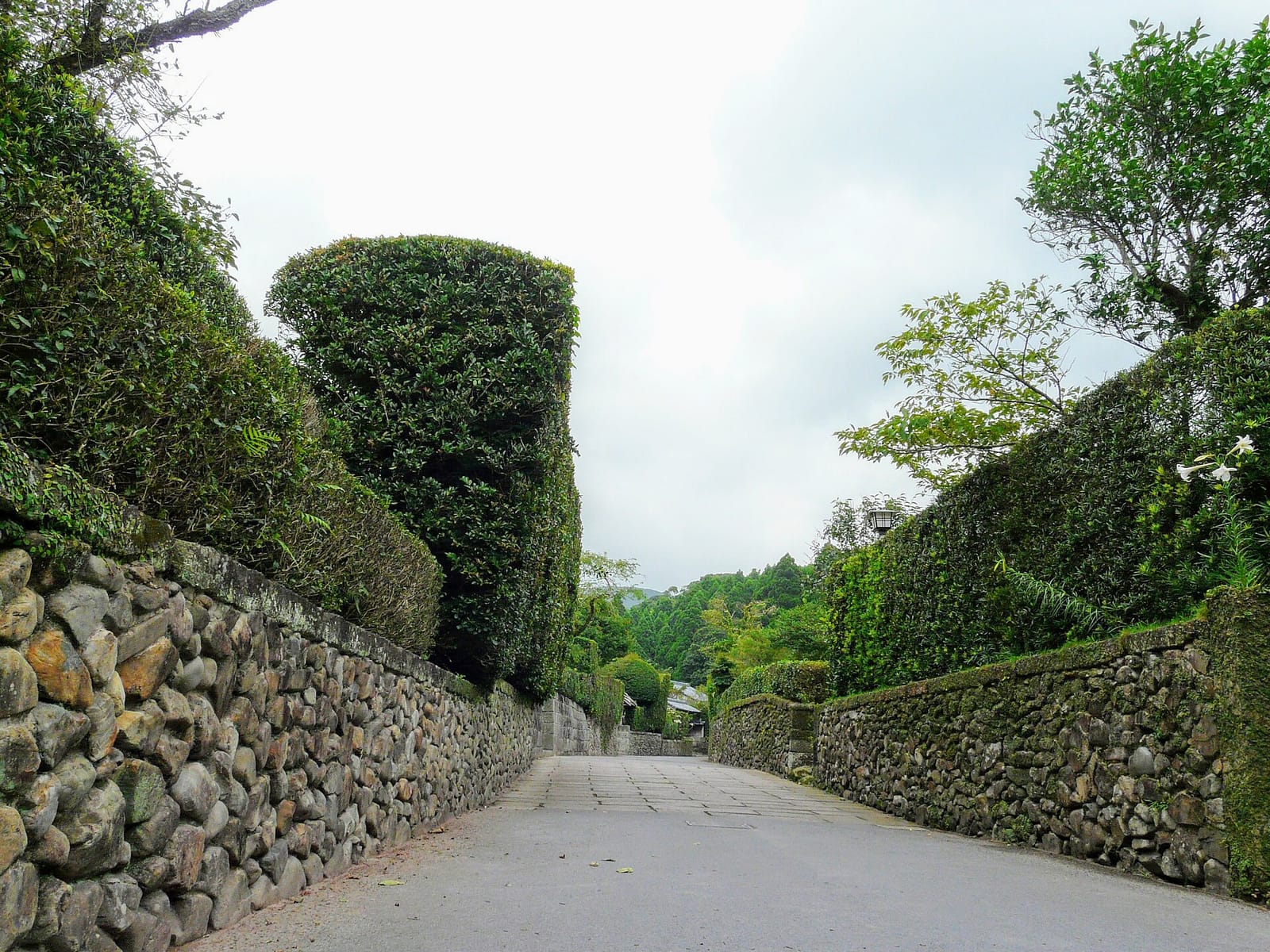
The samurai street of stone walls and hedges
Photo: Naokijp / CC BY-SA 4.0 · Original · Resized and croppedHistoric districts
Chiran, Minamikyushu
南九州市知覧 (みなみきゅうしゅうしちらん)
One of the Satsuma domain's samurai settlements known as fumoto, where samurai residences line streets of stone walls topped with neatly clipped hedges. Visitors can tour seven gardens designated as a national Place of Scenic Beauty in a town long called the Little Kyoto of Satsuma.
Key facts
- Designation
- Important Preservation Districts for Groups of Traditional Buildings
- Type
- Historic districts
- Location
- Minamikyushu, Kagoshima
- Address
- 鹿児島県南九州市
Before you go
- Opening hours
- The Chiran samurai residence gardens are open 9:00-17:00.
- Closed
- Open every day of the year.
- Admission (adults)
- Admission to all seven gardens is ¥530 for adults.
- Time needed
- Check the official site
- Getting there
- From Kagoshima-Chuo Station, take a Kagoshima Kotsu bus bound for Chiran and get off at Bukeyashiki-iriguchi or Nakagori; the district is right there. By car it is about 5 minutes from Chiran Kanayama Suisha IC on the Nansatsu Jukan Road or about 10 minutes from Chiran IC on the Ibusuki Skyline, and parking is free.
- Best time to visit
- Hina doll displays run from early February to late March, carp streamers fly over the Fumoto River from mid-April to mid-May, and in mid-November the Chiran Tosairo event lights the streets with bamboo lanterns.
- Good to know
- The gardens are a national Place of Scenic Beauty and also part of people's homes. There are no staff inside the gardens, so the audio guide available over free Wi-Fi at each garden is helpful. Local buses do not accept IC transit cards or ¥10,000, ¥5,000 or ¥2,000 notes, so carry ¥1,000 notes and coins.
Checked against official information on November 12, 2026. Fees and hours can change, so please also check the official site before you go.
Sources for visitor information
- Minamikyushu City: Chiran samurai residence gardens
- Minamikyushu City: Access from Kagoshima Airport and Kagoshima-Chuo Station
- Chiran Samurai Residence Gardens official site: Access
- Chiran Samurai Residence Gardens official site: Applications
- Kagoshima Prefecture: Chiran samurai residence gardens (accessibility information)
- Chiran Samurai Residence Gardens official site: Home
Key facts
- Designation
- Important Preservation Districts for Groups of Traditional Buildings
- Type
- Historic districts
- Location
- Minamikyushu, Kagoshima
- Address
- 鹿児島県南九州市
About this place
Chiran in Minamikyushu is one of the samurai settlements called "fumoto" in the Satsuma domain, covering about 18.6 hectares. In the Edo period the Satsuma domain governed its territory in 113 outer castle districts (togo), and a fumoto formed in each one. Chiran's fumoto is said to have been laid out in the mid-Edo period. It was selected as an Important Preservation District for Groups of Traditional Buildings in 1981.
The way the roads were laid out is what to look for in this town. The roads were divided around the administrative office called the Okariya, and the fortress-like land division that also served for defense is well preserved. Streets in the preservation district head toward the summits of surrounding hills and mountains, yet they bend along the way or meet at frequent three-way junctions, so the view ahead is blocked. The city suggests this may reflect a concern for defense. Honbaba-dori, an Edo-period road that is still the district's main street, looks toward Mt. Hahagatake straight ahead.
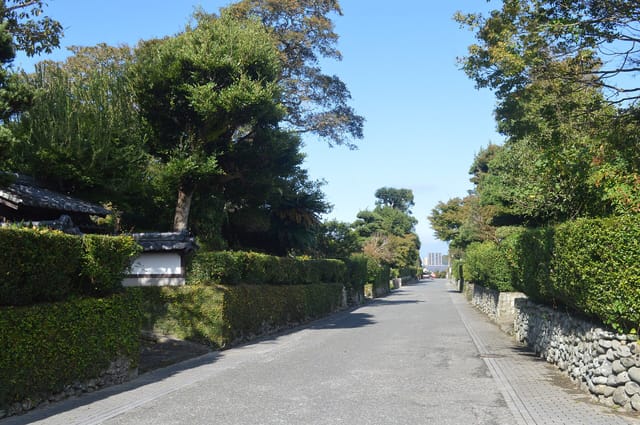
Stone walls continue along the streets, topped with large clipped hedges. Each residence has a garden that harmonizes with the main house, and the city explains that the whole area is built like a garden city that makes good use of nature. The gardens of outstanding design were designated in February 1981 as the Chiran Fumoto Gardens, a national Place of Scenic Beauty, covering seven gardens in the district. The city's material shows the Morishige Kenshi garden in a photograph as one of them. The city's material includes a photograph looking at the district from the east, with the remains of Kikko Castle in the foreground.
Tracing the history of preservation shows that it was tied to tourism from early on. From the early 1970s the area was introduced in academic surveys, and in 1970 a tourist pamphlet with the slogan "Little Kyoto of Satsuma" was issued. In 1973 the adjacent prefectural road was improved to harmonize with the samurai residences' scenery, and in 1980 the preservation ordinance was passed. In 2008 the Morishige Kenshi and Sata Naotada residences were designated prefectural tangible cultural properties. Work on that prefectural road continued until fiscal 1996, and the street trees planted are the same inumaki (podocarpus) used in the hedges.
According to a 2026 summary by Minamikyushu City, more than 140 repairs and landscape improvements have been carried out since selection with the understanding and cooperation of residents. In 2019 it was certified as the Japan Heritage site "The Town Where Satsuma Samurai Lived: Walking the Samurai Residence Districts 'Fumoto.'" Events continue as well, such as the autumn bamboo-lantern event "Akari no Michishirube - Chiran Tosairo" and the "Chiran Hina Festival" at some open facilities. The city says visitor numbers have been declining in recent years, but that public and private sectors are jointly working on projects to build an attractive destination.
About the district
- Type of district
- samurai residence town
- Area
- 18.6 hectares
- Selected
- November 30, 1981
Sources and date checked
Facts such as eras, structures and locations are edited and translated by us from the Agency for Cultural Affairs’ database of nationally designated cultural properties. The Agency and the national government did not produce this page.
Database of nationally designated cultural properties- Agency for Cultural Affairs, Database of National Cultural Properties
- Minamikyushu City Chiran (prepared by Minamikyushu City, published by Agency for Cultural Affairs)
Checked on November 6, 2026
Report an error
If you notice a mistake, please tell us along with a source for the correct information.
Where to go next
Places you could see on the same day, and places worth comparing.
More from Kagoshima
Discover more of the same region on our sister sites.
Meiga no Furusato
Paintings linked to Kagoshima
- Famous Places in the Sixty-odd Provinces: Osumi Province: Sakurajima
- Famous Places in the Sixty-odd Provinces: Satsuma Province: The Twin-Sword Rocks at Bonoura
- Atelier
- Nude
Sake Tabi
Breweries and distilleries in Kagoshima
- Kojika Shuzo
- Satsuma Shuzo Meijigura (Kedogawa Distillery)
- Amami Beer Hall (Amami Beer)
- Amami Oshima Kaiun Shuzo (Lento)