Kirishima Jingu
Photo: MaedaAkihiko / CC BY-SA 4.0 · Original · Resized and croppedEdo period · Shrines · National Treasures
Kirishima Jingu
霧島神宮 (きりしまじんぐう)
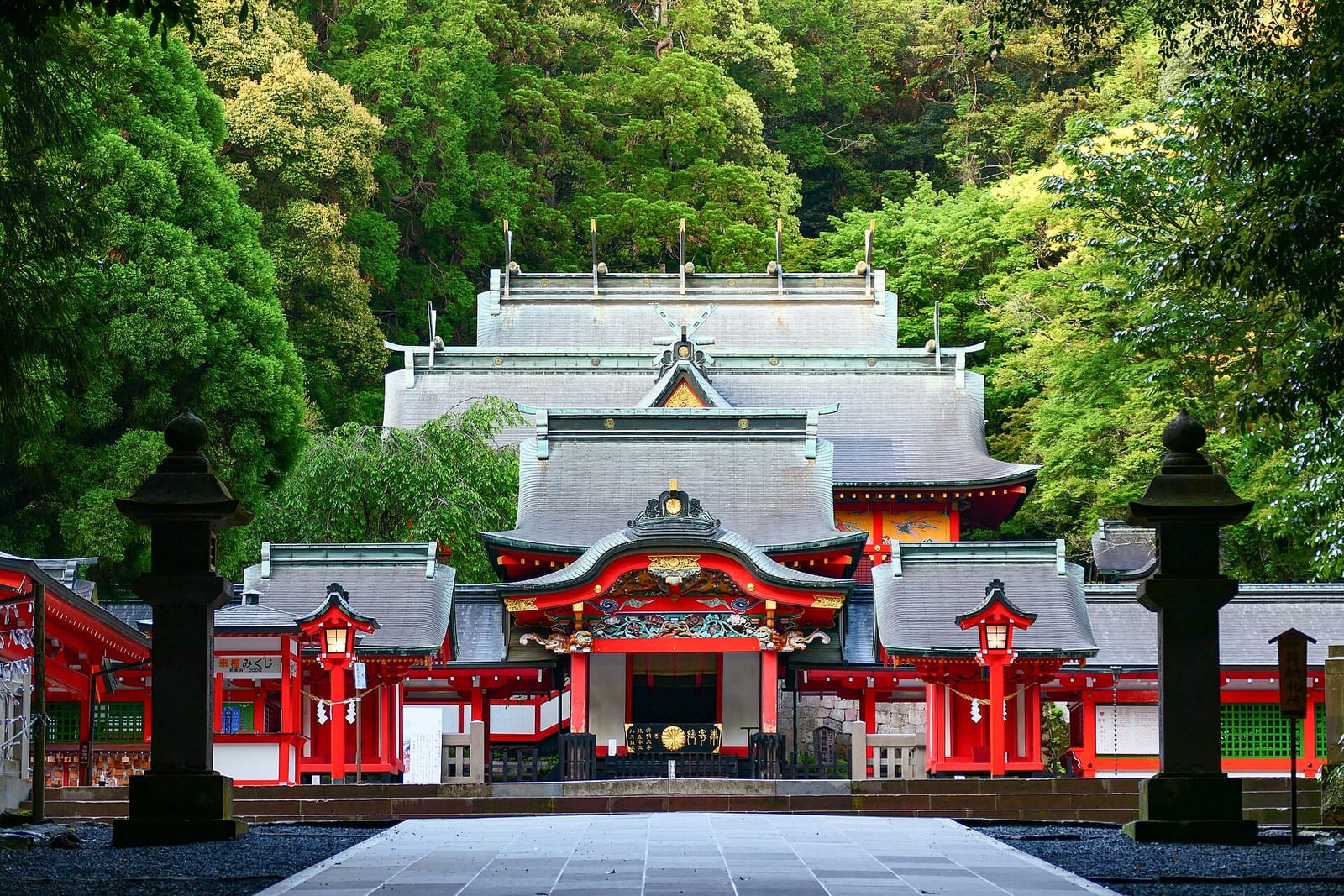
At Kirishima Jingu you can see the vermilion Main Sanctuary, Offering Hall and Worship Hall, rebuilt in 1715, rising in stages, linked to the Chokushiden by a climbing corridor and steep stairs. The interiors of the halls can be seen during special viewings by reservation.
Key facts
- Designation
- National Treasures
- Era
- Edo period
- Type
- Shrines
- Location
- Kirishima, Kagoshima
- Address
- 鹿児島県霧島市霧島田口2608番地5
Before you go
- Opening hours
- The grounds are open at all times. The amulet office is open 8:00 to 17:00, and prayer requests are accepted 9:00 to 16:30.
- Closed
- Open every day of the year.
- Admission (adults)
- Visiting the shrine is free. The special viewing inside the National Treasure halls costs 2,000 yen per person (free for junior high school students and younger; reservation required).
- Time needed
- Check the official site
- Getting there
- Route buses run from Kagoshima Airport, JR Kirishima-Jingu Station and JR Kokubu Station; from the airport you change at Maruo. Since April 2026 the Kirishima Jingu Access Bus has also run, using only the Kirishima "Nottari Oritari Plan" one-day pass (adults 1,500 yen, also sold on board). By car, come from Mizobe-Kagoshima-Kuko IC or Takaharu IC; there is a free car park for 500 cars.
- Best time to visit
- Special viewings inside the National Treasure halls are held on set dates; in 2026 they ran in June and October, four times a day (10:00, 11:00, 14:00, 15:00) by reservation. Check the shrine's notices for future dates.
- Good to know
- The main approach climbs about 80 steep stone steps from the sacred bridge. The main hall's wall paintings and the offering hall's dragon pillars are not normally open to view. During special viewings, photography is not allowed, modest dress and socks are required, and there are steep stairs.
Checked against official information on November 13, 2026. Fees and hours can change, so please also check the official site before you go.
Sources for visitor information
Key facts
- Designation
- National Treasures
- Era
- Edo period
- Type
- Shrines
- Location
- Kirishima, Kagoshima
- Address
- 鹿児島県霧島市霧島田口2608番地5
About this place
Kirishima Jingu is a Shinto shrine in Kirishima, Kagoshima Prefecture. Its principal deity is Ninigi-no-Mikoto, who is said to have descended to Takachiho-no-mine at the command of Amaterasu-Omikami, and six other deities, beginning with his consort Konohanasakuya-hime, are enshrined alongside him. According to the shrine's history, it has been linked since the age of the gods with Takachiho-no-mine, the peak that rises behind it, and it is recorded as Kirishima Shrine in Morokata District, Hyuga Province, in the Engishiki of the Heian period. On the summit of Takachiho-no-mine stands the Ama-no-Sakahoko, a heavenly upside-down spear.
The shrine buildings were lost to eruptions and fire several times and were restored each time. According to old records cited by the shrine, it was first enshrined between Takachiho-no-mine and the Ohachi crater, but it burned in an eruption, and in 950 the Tendai monk Shoku rebuilt it at Takachiho-gawara. It was damaged again in a great eruption in 1234, and in 1484 the Shingon monk Kenkei rebuilt it on the orders of Shimazu Tadamasa. Later it burned down completely in a fire that spread from Karin-ji, the temple that managed the shrine, and the present buildings were rebuilt in 1715 with a donation from Shimazu Yoshitaka, the 21st head of the Shimazu family.
The present Main Sanctuary, Offering Hall and Worship Hall became Important Cultural Properties in 1989 and were designated National Treasures on February 9, 2022. From the Chokushiden (Imperial Envoy Hall) you pass along a climbing corridor to the Worship Hall and the Offering Hall, and the Main Sanctuary stands at the highest point. Between the Worship Hall and the Main Sanctuary, steep stairs create changes in level, giving a dynamic layout that makes use of the height difference. The Main Sanctuary is five bays wide and four bays deep with a hip-and-gable roof, and five sets of chigi and katsuogi ornaments sit on its copper-plate roof. The Worship Hall is seven bays wide with a hip-and-gable roof and a chidori-hafu gable on the front.
The buildings are finished in lacquer with vermilion and rich colors, and the Main Sanctuary is lavishly decorated even in the inner sanctum that no one sees. Inside, the Main Sanctuary has an outer chamber, an inner chamber and a room behind them; paintings of the four arts (the zither, go, calligraphy and painting) fill the small walls above the beams, and paintings of the Twenty-Four Filial Exemplars, tales of devotion to parents, cover the three surrounding sides. The transoms of the outer chamber are carved with Chinese lions and heavenly maidens playing music, and on the dragon pillars of the front porch, a dragon with an open mouth and a dragon with a closed mouth holding a jewel form an a-un pair. The shrine says the local character unique to the Satsuma Domain seen in these dragon pillars was one of the points valued in the designation.
The main approach climbs steep stone steps from the vermilion sacred bridge and then continues to the second and third torii gates. From a lookout that juts out to the west along the way, on clear days you can see as far as Kagoshima Bay, Sakurajima, the city of Kagoshima and Kaimondake. The grounds also have the Kaguraden (sacred dance hall), the sazare-ishi stone and the Monument to the Divine Descent. The wall paintings and dragon pillars of the main sanctuary are not normally open to the public, and the paintings are covered with fog screens. You can go up into the halls only during special viewings held for limited periods by reservation; after a purification rite and worship, you hear an explanation of the buildings.
Buildings designated as National Treasures
Kirishima Jingu Main Sanctuary, Offering Hall and Worship Hall
- Era
- Mid-Edo period
- Year
- 1715
- Structure
- Main sanctuary: five bays wide, four bays deep, single-story, hip-and-gable roof, one-bay porch (kohai), with a rain-shield (kirishi) addition
- Designated
- February 9, 2022
Sources and date checked
Facts such as eras, structures and locations are edited and translated by us from the Agency for Cultural Affairs’ database of nationally designated cultural properties. The Agency and the national government did not produce this page.
Database of nationally designated cultural properties- Agency for Cultural Affairs, Database of National Cultural Properties: Kirishima Jingu Main Sanctuary, Offering Hall and Worship Hall
- Kirishima Jingu: History (Kirishima Jingu official)
- Kirishima Jingu: National Treasure Designation of the Main Sanctuary, Offering Hall and Worship Hall (Kirishima Jingu official)
- Kirishima Jingu: Guide to the Grounds (Kirishima Jingu official)
- Kirishima Jingu: Special Viewing Notice (Kirishima Jingu official)
Checked on November 6, 2026
Report an error
If you notice a mistake, please tell us along with a source for the correct information.
Where to go next
Places you could see on the same day, and places worth comparing.
More from Kagoshima
Discover more of the same region on our sister sites.
Meiga no Furusato
Paintings linked to Kagoshima
- Famous Places in the Sixty-odd Provinces: Osumi Province: Sakurajima
- Famous Places in the Sixty-odd Provinces: Satsuma Province: The Twin-Sword Rocks at Bonoura
- Atelier
- Nude
Sake Tabi
Breweries and distilleries in Kagoshima
- Kojika Shuzo
- Satsuma Shuzo Meijigura (Kedogawa Distillery)
- Amami Beer Hall (Amami Beer)
- Amami Oshima Kaiun Shuzo (Lento)