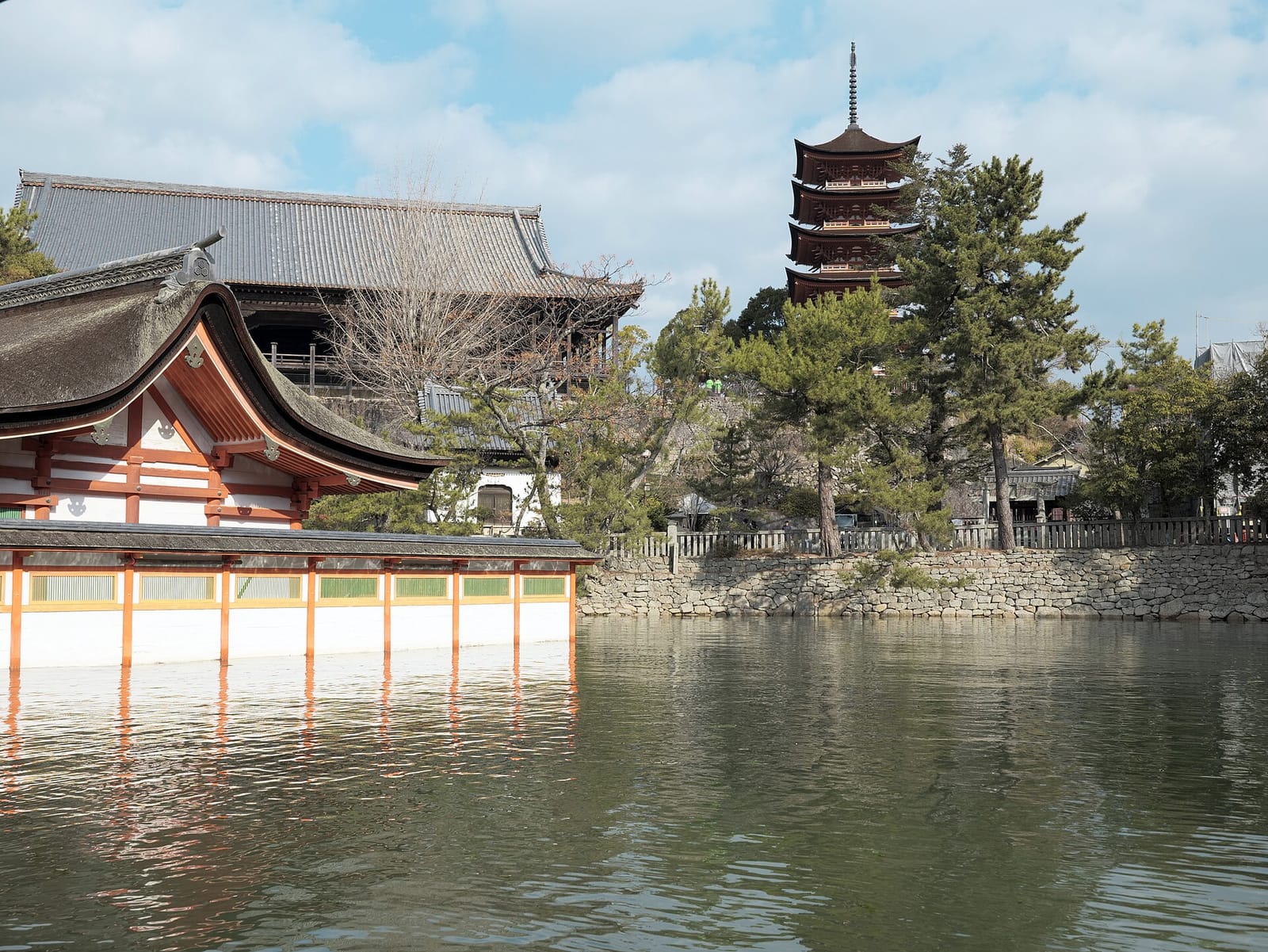
Shrine buildings over the sea, with the five-story pagoda
Photo: Hyppolyte de Saint-Rambert / CC BY 4.0 · Original · Resized and croppedKamakura period · Shrines · National Treasures
Itsukushima Shrine
厳島神社 (いつくしまじんじゃ)
Itsukushima Shrine's vermilion halls and corridors stand over the sea, shaped by Taira no Kiyomori in the style of Heian aristocratic mansions. Six structures, including the main shrine, the Marodo Shrine and the east and west corridors, are National Treasures, and the view changes with the tide.
Key facts
- Designation
- National Treasures
- Era
- Kamakura period
- Type
- Shrines
- Location
- Hatsukaichi, Hiroshima
- Address
- 広島県廿日市市宮島町
Before you go
- Opening hours
- 6:30–18:00 (until 17:30 from January 4 to the end of February and from October 15 to November 30; until 17:00 in December; 0:00–18:30 on January 1; until 18:30 on January 2–3). The Treasure Hall is open 8:00–17:00.
- Closed
- Open every day.
- Admission (adults)
- Shrine admission is ¥300 for adults, and the Treasure Hall is ¥300. A combined ticket for both costs ¥500 (sold only at the shrine entrance).
- Time needed
- Check the official site
- Getting there
- Take the JR Sanyo Line from Hiroshima Station to Miyajimaguchi Station (about 25 min), then a ferry (JR West Miyajima Ferry or Miyajima Matsudai Kisen) to the island (about 10 min). The shrine has no parking, so leave your car at a lot near Miyajimaguchi.
- Best time to visit
- The Kangensai, one of Japan's three great boat festivals, is held on the 17th day of the 6th lunar month (July 30 in 2026). Bugaku court dances and Noh are performed at the Peach Blossom Festival on April 15 and the Chrysanthemum Festival on October 15.
- Good to know
- When crossing to Miyajima by boat, a ¥100 Miyajima Visitor Tax is charged on top of the fare. The East Corridor is under structural reinforcement work (scheduled until December 2026). The corridor floor has gaps, so be careful with high heels.
Checked against official information on November 12, 2026. Fees and hours can change, so please also check the official site before you go.
Sources for visitor information
Key facts
- Designation
- National Treasures
- Era
- Kamakura period
- Type
- Shrines
- Location
- Hatsukaichi, Hiroshima
- Address
- 広島県廿日市市宮島町
About this place
According to the shrine's own account, Saeki no Kuramoto, who governed the island, built the shrine on its present site in 593, the year Empress Suiko took the throne. The national cultural property commentary, however, describes the founding date as unclear. The deities are three goddesses, Ichikishimahime, Tagorihime, and Tagitsuhime. Taira no Kiyomori, who became governor of Aki, revered the shrine deeply and in 1168 (Nin'an 3) rebuilt it in a style drawing on shinden-zukuri palace architecture. As his rank rose, more members of the imperial family and nobility came to worship, with the Retired Emperor Go-Shirakawa visiting in 1174 (Joan 4) and the Retired Emperor Takakura in 1180 (Jisho 4).
The shrine burned in 1207 and 1223, and building work in 1241 (Ninji 2) largely established the present complex. Six buildings are designated National Treasures: the honden, heiden, and haiden of the main shrine; the harae-den (purification hall) of the main shrine; the honden, heiden, and haiden of the Marodo-jinja subsidiary shrine; the harae-den of Marodo-jinja; the east corridor; and the west corridor. The heiden, haiden, and harae-den of the main shrine and the Marodo-jinja halls are dated to 1241, while the honden of the main shrine underwent major repairs in 1571 (Genki 2). The main honden is a single-story building with a double-flowing roof (ryonagare-zukuri) in cypress bark, eight bays across the front, nine across the back, and four deep. The east corridor dates from 1558 to 1615 and the west corridor from 1563 to 1602, and both are classed as Momoyama period. That buildings of different dates stand together as one complex is what to look for here. The harae-den are hip-and-gable halls entered on the gable side, with the rear connected by roof. The main shrine and Marodo-jinja each have one, so they are worth comparing.
The vermilion corridors link the main shrine and Marodo-jinja and extend 107 bays in all. The National Treasure east corridor bends along 45 bays, and the west corridor likewise along 62. Besides the corridors and halls, the great torii standing in the sea is central to the scene. The torii is not a National Treasure but an Important Cultural Property; the present one was rebuilt in 1875 (Meiji 8) and is said to be the ninth since the Heian period. At 16.6 meters high, it is said to be the largest wooden torii in Japan. The Noh stage in the grounds is also an Important Cultural Property. When viewing the buildings over the sea, keep in mind that the tide changes how they look.
The Treasure Hall, directly opposite the corridor exit, was completed in 1934 (Showa 9) and is a Registered Tangible Cultural Property. It is said to be the first building in Japan to coat concrete with lacquer to resemble a wooden structure, and it displays part of the shrine's treasures. Itsukushima Shrine was inscribed on the UNESCO World Heritage List in 1996 (Heisei 8). The official route runs from the east corridor through Marodo-jinja, the main shrine, and the Hirabutai platform to the west corridor, then past the Noh stage and the Sorihashi bridge to the exit. Visiting hours and tide conditions vary by day, so check the latest information on the official site before you go. It is located in Miyajima-cho, Hatsukaichi, Hiroshima Prefecture.
Buildings designated as National Treasures
Itsukushima Shrine Main Shrine: Honden, Heiden and Haiden
- Era
- Late Muromachi period
- Structure
- Main sanctuary: 8 bays wide at the front, 9 bays at the rear, 4 bays deep, single-story, ryo-nagare-zukuri (double-slope) roof, cypress-bark roofing
- Designated
- March 29, 1952
Itsukushima Shrine Main Shrine Haraiden (Purification Hall)
- Era
- Early Kamakura period
- Year
- 1241
- Structure
- 6 bays wide, 3 bays deep, single-story, hip-and-gable roof, entered through the gable end, joined to the rear roof, cypress-bark roofing
- Designated
- March 29, 1952
Itsukushima Shrine Marodo Shrine (Auxiliary Shrine): Honden, Heiden and Haiden
- Era
- Early Kamakura period
- Year
- 1241
- Structure
- Main sanctuary: 5 bays wide, 4 bays deep, single-story, ryo-nagare-zukuri (double-slope) roof, cypress-bark roofing
- Designated
- March 29, 1952
Itsukushima Shrine Marodo Shrine (Auxiliary Shrine) Haraiden
- Era
- Early Kamakura period
- Year
- 1241
- Structure
- 4 bays wide, 3 bays deep, single-story, hip-and-gable roof, entered through the gable end, joined to the rear worship hall roof, cypress-bark roofing
- Designated
- March 29, 1952
Itsukushima Shrine East Corridor
- Era
- Momoyama period
- Structure
- Bent corridor, 45 bays in total length, single-story, gable roof, cypress-bark roofing
- Designated
- March 29, 1952
Itsukushima Shrine West Corridor
- Era
- Momoyama period
- Structure
- Bent corridor, 62 bays in total length, single-story, gable roof at the east end, karahafu gable at the west end, cypress-bark roofing
- Designated
- March 29, 1952
Sources and date checked
Facts such as eras, structures and locations are edited and translated by us from the Agency for Cultural Affairs’ database of nationally designated cultural properties. The Agency and the national government did not produce this page.
Database of nationally designated cultural properties- Agency for Cultural Affairs, Database of National Cultural Properties: Itsukushima Shrine Main Shrine: Honden, Heiden and Haiden
- Agency for Cultural Affairs, Database of National Cultural Properties: Itsukushima Shrine Main Shrine Haraiden (Purification Hall)
- Agency for Cultural Affairs, Database of National Cultural Properties: Itsukushima Shrine Marodo Shrine (Auxiliary Shrine): Honden, Heiden and Haiden
- Agency for Cultural Affairs, Database of National Cultural Properties: Itsukushima Shrine Marodo Shrine (Auxiliary Shrine) Haraiden
- Agency for Cultural Affairs, Database of National Cultural Properties: Itsukushima Shrine East Corridor
- Agency for Cultural Affairs, Database of National Cultural Properties: Itsukushima Shrine West Corridor
- Kotobank: Itsukushima Shrine
- Itsukushima Shrine official site
- Itsukushima Shrine official site: History
- Itsukushima Shrine official site: Cultural Properties and Buildings
- Itsukushima Shrine official site: Visiting Route
- Miyajima Tourism Association: Great Torii
Checked on November 6, 2026
Report an error
If you notice a mistake, please tell us along with a source for the correct information.
Where to go next
Places you could see on the same day, and places worth comparing.
Nearby cultural heritage
Places within 10 km, nearest first. Distances are in a straight line.
More from Hiroshima
Discover more of the same region on our sister sites.
Meiga no Furusato
Paintings linked to Hiroshima
- Famous Places in the Sixty-odd Provinces: Bingo Province: Kannon Temple at Abuto
- Famous Places in the Sixty-odd Provinces: Aki Province: Festival at the Itsukushima Shrine
- Daubigny's Garden