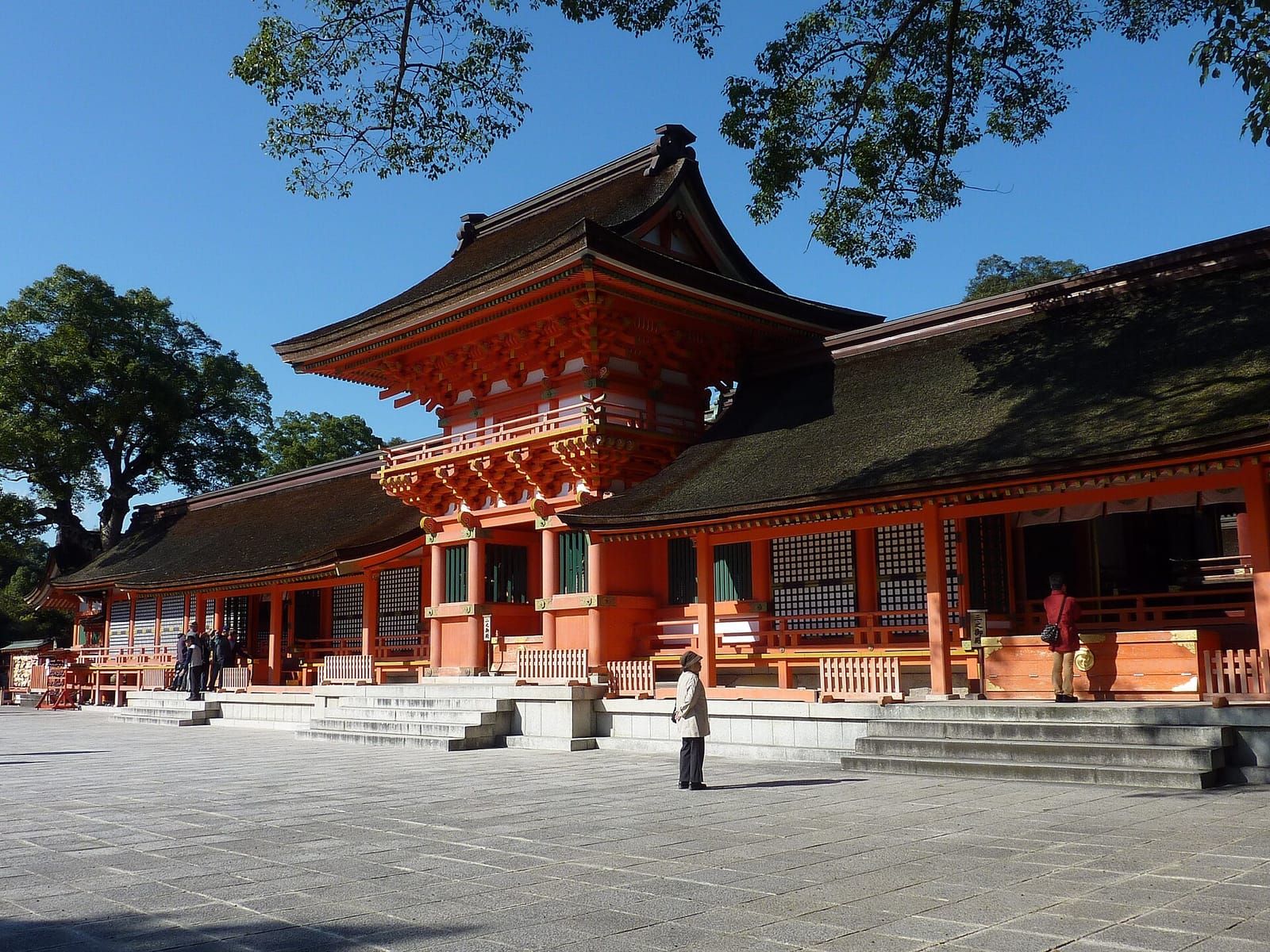
Usa Jingu
Photo: ja:User:Sanjo / CC BY-SA 3.0 · Original · Resized and croppedEdo period · Shrines · National Treasures
Usa Jingu
宇佐神宮 (うさじんぐう)
At Usa Jingu, the three National Treasure halls of the main sanctuary, built in the ancient Hachiman-zukuri style, stand side by side at the upper shrine, and in the grounds you can also see the Usa torii, the lower shrine, the roofed Kurebashi bridge and a great camphor tree. The main sanctuary is normally closed and is sometimes opened during periods such as special viewings.
Key facts
- Designation
- National Treasures
- Era
- Edo period
- Type
- Shrines
- Location
- Usa, Oita
- Address
- 大分県宇佐市大字南宇佐
Before you go
- Opening hours
- The grounds are always open; the upper shrine (Jogu) can be visited 6:00 to 18:00 (except over the New Year period).
- Closed
- The shrine grounds have no closing days.
- Admission (adults)
- Visiting the shrine grounds is free (parking is charged).
- Time needed
- Check the official site
- Getting there
- The nearest station is Usa on the JR Nippo Line (about 40 minutes from Oita or about 1 hour 30 minutes from Hakata by limited express). From Usa Station take a bus bound for Yokkaichi to Usa Hachiman, or a taxi. From Oita Airport, the Oita Airport limousine bus for Nakatsu, Usa and Bungo-Takada stops at Usa Hachiman (1,550 yen). By car it is about 15 minutes from Usa IC, and there are paid car parks nearby (500 yen for a car, among others).
- Good to know
- A local saying holds that skipping the lower shrine makes a visit only half complete, so by custom visitors pray at both the upper shrine (Jogu) and the lower shrine (Gegu). Worship is two bows, four claps and one bow. The National Treasure main sanctuary is normally closed, and is sometimes opened for limited periods such as special viewings. A monorail beside the Nandaimon gate runs up to the upper shrine (9:00 to 15:30), and the shrine office lends wheelchairs.
Checked against official information on November 13, 2026. Fees and hours can change, so please also check the official site before you go.
Sources for visitor information
Key facts
- Designation
- National Treasures
- Era
- Edo period
- Type
- Shrines
- Location
- Usa, Oita
- Address
- 大分県宇佐市大字南宇佐
About this place
Usa Jingu is a Shinto shrine in Usa, Oita Prefecture. According to Usa City and the Usa City Tourism Association, it is the head shrine of the Hachiman shrines, which number more than 40,600 across Japan. It was founded in 725 and has a history of about 1,300 years. It is one of the chokusaisha, shrines to which the emperor sends an imperial envoy, and in Kyushu only Usa Jingu and Kashii-gu in Fukuoka Prefecture hold this status. In the 12th century it is said to have held more than a third of the estates (shoen) in Kyushu, which shows how powerful it was at the time.
Usa Jingu is also said to be the place where the fusion of Shinto and Buddhism began. According to the city, after the imperial court put down a rebellion of the Hayato people of southern Kyushu in 720, epidemics and poor harvests followed, and the god Hachiman, regretting the killing in that war, turned to Buddhism for salvation and held a Hojo-e, a rite of releasing living creatures; this is said to be the beginning. When the shrine moved to its present site in 725, Miroku-ji temple was built, and in 737 it moved to the west of the shrine buildings; the bond between them lasted until the Meiji period. In 749, when the Great Buddha of Todai-ji was completed, Hachiman is said to have traveled to Nara in a purple palanquin, and this is regarded as the origin of the portable shrine (mikoshi). Mikoshi can still be seen at the Gojinko-sai (Nagoshi Festival) and the Chushu-sai (Hojo-e), as well as in the treasure hall.
The National Treasure main sanctuary stands at the upper shrine (Jogu). Inside the area enclosed by the Nanchu-romon gate, the First, Second and Third Halls stand in a row from left to right as you face them. They enshrine Hachiman Okami (Emperor Ojin), Hime Okami and Empress Jingu respectively. The three halls date from the end of the Edo period; the date entry in the national cultural properties database gives their construction as Ansei 2 to Bunkyu 1 (1855 to 1862 in the Western calendar), and all three were designated National Treasures in 1952.
The main sanctuary is built in an old style called Hachiman-zukuri and is designated a National Treasure as a valuable building. According to the structure entry in the database, each hall consists of an inner hall (Nai-in) and an outer hall (Ge-in), and the connecting section (tsukuriai) between them is counted as part of the same building. The inner hall is three bays wide and two bays deep with a gabled roof, the outer hall is three bays wide and one bay deep with a front porch, and both have cypress-bark roofs. The main sanctuary is normally closed and can sometimes be seen only during limited periods such as special viewings. The Usa torii gate at the entrance to the upper shrine has a top beam that curves upward, no central name tablet, and black rings at the tops of the pillars, and every torii in the grounds is of this type.
The grounds cover about 500,000 square meters, and you can walk among groves of ichiigashi oak and other trees and past a lotus pond. Below the upper shrine stands a great camphor tree, estimated to be 800 years old and about 30 meters tall. The lower shrine (Gegu) was once the hall where food offerings were cooked, and it enshrines the same three deities as the upper shrine; it has long been loved through the local saying that skipping it makes a visit only half complete. The Kurebashi bridge, with a cypress-bark roof, is said to have been built before the Kamakura period, and its doors open so that it can be crossed at the imperial festival held once every ten years. The treasure hall displays the Peacock-Pattern Kei gong, one of Oita Prefecture's National Treasures.
Buildings designated as National Treasures
Usa Jingu Main Sanctuary (First Hall)
- Era
- End of the Edo period
- Structure
- Inner precinct (Nai-in): three bays wide, two bays deep, single-storied, gabled roof, cypress-bark roofing
- Designated
- November 22, 1952
Usa Jingu Main Sanctuary (Second Hall)
- Era
- End of the Edo period
- Structure
- Inner precinct (Nai-in): three bays wide, two bays deep, single-storied, gabled roof, cypress-bark roofing
- Designated
- November 22, 1952
Usa Jingu Main Sanctuary (Third Hall)
- Era
- End of the Edo period
- Structure
- Inner precinct (Nai-in): three bays wide, two bays deep, single-storied, gabled roof, cypress-bark roofing
- Designated
- November 22, 1952
Sources and date checked
Facts such as eras, structures and locations are edited and translated by us from the Agency for Cultural Affairs’ database of nationally designated cultural properties. The Agency and the national government did not produce this page.
Database of nationally designated cultural properties- Agency for Cultural Affairs, Database of National Cultural Properties: Usa Jingu Main Sanctuary (First Hall)
- Agency for Cultural Affairs, Database of National Cultural Properties: Usa Jingu Main Sanctuary (Second Hall)
- Agency for Cultural Affairs, Database of National Cultural Properties: Usa Jingu Main Sanctuary (Third Hall)
- Usa Jingu (Usa City Official Tourism Site)
- Usa Jingu (Usa City Tourism Association)
Checked on November 6, 2026
Report an error
If you notice a mistake, please tell us along with a source for the correct information.
Where to go next
Places you could see on the same day, and places worth comparing.
More from Oita
Discover more of the same region on our sister sites.
Meiga no Furusato
Paintings linked to Oita
- Famous Places in the Sixty-odd Provinces: Chikugo Province: Fish Weirs in the Rapids
- Famous Places in the Sixty-odd Provinces: Buzen Province: The Road below Rakan Temple
- Famous Places in the Sixty-odd Provinces: Bungo Province: Minosaki
Sake Tabi
Breweries and distilleries in Oita
- Sapporo Breweries Kyushu Hita Brewery
- Ajimu Winery (Sanwa Shurui)
- Beppu Brewery
- Karashima Kokuunokura (Sanwa Shurui)