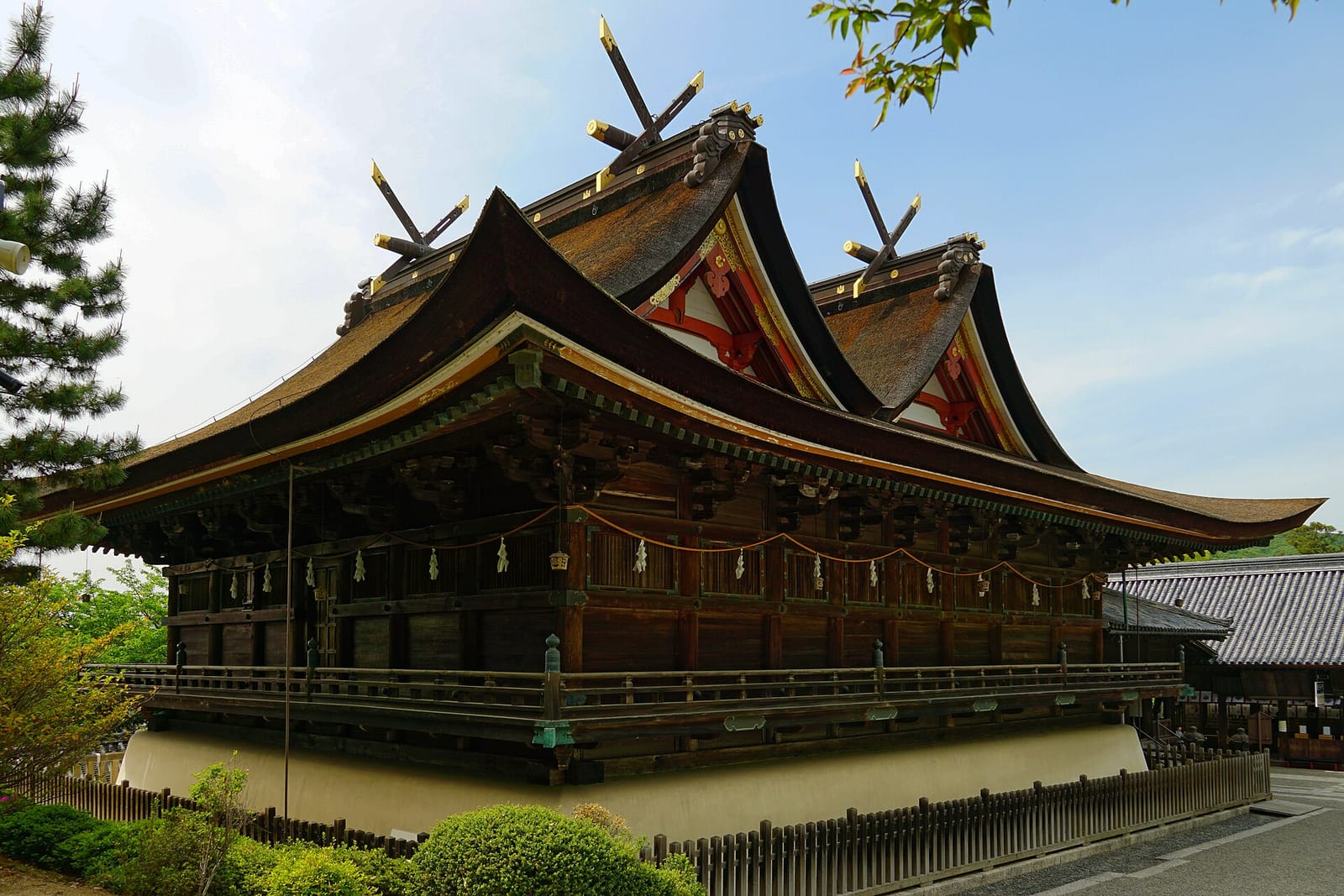
Kibitsu Shrine
Photo: 663highland / CC BY-SA 4.0 · Original · Resized and croppedMuromachi period · Shrines · National Treasures
Kibitsu Shrine
吉備津神社 (きびつじんじゃ)
At Kibitsu Shrine you can see the Honden, the only example in Japan of hiyoku-irimoya-zukuri (Kibitsu-zukuri), in which two hip-and-gable roofs are joined into one, and the Haiden attached to its front. The Narukama Shinji rite tied to the legend of the defeat of Ura and the long, straight covered corridor are other highlights.
Key facts
- Designation
- National Treasures
- Era
- Muromachi period
- Type
- Shrines
- Location
- Okayama, Okayama
- Address
- 岡山県岡山市吉備津
Before you go
- Opening hours
- Check the official site
- Closed
- Check the official site
- Admission (adults)
- Check the official site
- Time needed
- Check the official site
- Getting there
- Take the JR Kibi (Momotaro) Line from Okayama Station to Kibitsu Station (about 17 min) and walk about 10 minutes. By car, it is 15 minutes from the Okayama-Soja or Okayama interchanges.
Checked against official information on November 12, 2026. Fees and hours can change, so please also check the official site before you go.
Sources for visitor information
Key facts
- Designation
- National Treasures
- Era
- Muromachi period
- Type
- Shrines
- Location
- Okayama, Okayama
- Address
- 岡山県岡山市吉備津
About this place
Kibitsu Shrine stands at the foot of Mt. Kibi-no-Nakayama in Kibitsu, Okayama. Its principal deity is Okibitsuhiko-no-Mikoto, enshrined together with deities of his clan such as his half-brother Wakahikotakekibitsuhiko-no-Mikoto and Kibitakehiko-no-Mikoto. According to the shrine, it was originally the chief guardian shrine of the province of Kibi, and after Kibi was divided into Bizen, Bitchu and Bingo it became the Ichinomiya (leading shrine) of Bitchu, which is why it is called the "Ichinomiya of the Three Bi Provinces." No record of its founding survives; one tradition says a fifth-generation descendant of Kibitsuhiko first enshrined him, and another says Emperor Nintoku built the shrine.
According to shrine tradition, Kibitsuhiko was sent by the imperial court, set up camp on Mt. Kibi-no-Nakayama and defeated Ura, who had tormented the people from his base at Kinojo, and this story is said to be one source of the folk tale of Momotaro. The Yaoki-iwa, a rock on which he is said to have laid his arrows, remains in the grounds, and every year on January 3 the Yadate Shinji is held, in which arrows are shot in all four directions to ward off misfortune. In the Japan Heritage story "Okayama, the Birthplace of the Legend of Momotaro," which is built around this legend, eight of the component cultural properties belong to the shrine.
The Honden (Main Sanctuary) and Haiden (Worship Hall), the National Treasure, were built as a single structure. According to the shrine, after burning down twice they were rebuilt over about 25 years, starting in the time of the shogun Ashikaga Yoshimitsu in the Muromachi period, and completed in 1425; they have never been dismantled for repair since. The Honden measures about 14.6 meters by about 17.7 meters with a ridge about 12 meters high, second in size only to Yasaka Shrine in Kyoto. Two hip-and-gable roofs are set front and back, joined by ridges of the same height and covered as one large cypress-bark roof, a form called hiyoku-irimoya-zukuri, or Kibitsu-zukuri.
The Honden faces north on a base of white plaster and uses 68 round pillars about 48 cm across and about 6 meters tall. Its deep eaves extend without supporting posts, held up by inserted bracket arms of the Daibutsu style, which the monk Chogen, who worked to rebuild Todai-ji, brought from the continent. Inside, the floor and ceiling rise higher as you move from the outer sanctuary toward the innermost sanctuary. The Haiden, built at the same time, projects from the front of the Honden; it is surrounded on the front and both sides by a mokoshi (skirt roof) covered with tiles. At the shrine's renewal in 1910 (Meiji 43), only the Haiden was dismantled and repaired.
From the Honden, a covered corridor rebuilt in 1579 (Tensho 7) runs in a straight line, following the natural slope. The shrine's grounds map gives its length as 360 meters, while its page on the grand festivals says it extends 300 meters. A branch partway along leads to the Okamaden (Important Cultural Property), rebuilt in 1612, where the Narukama Shinji is performed, a rite that reads wishes from the sound of a boiling cauldron (closed on Fridays; apply by 14:00). At the grand festivals on the second Sundays of May and October, a procession carries 75 trays of offerings along the corridor in the Shichijugozen-sue Shinji. Peonies in late April, hydrangeas in June and a ginkgo tree about 600 years old that turns yellow in early November are also highlights.
Buildings designated as National Treasures
Kibitsu Shrine Honden and Haiden (Main Sanctuary and Worship Hall)
- Era
- Mid-Muromachi period
- Year
- 1425
- Structure
- Main sanctuary: 5 bays wide at the front, 7 bays at the rear, 8 bays deep, single-story, hiyoku-irimoya (paired hip-and-gable) roof, cypress-bark roofing
- Designated
- March 29, 1952
Sources and date checked
Facts such as eras, structures and locations are edited and translated by us from the Agency for Cultural Affairs’ database of nationally designated cultural properties. The Agency and the national government did not produce this page.
Database of nationally designated cultural properties- Agency for Cultural Affairs, Database of National Cultural Properties: Kibitsu Shrine Honden and Haiden (Main Sanctuary and Worship Hall)
- About Kibitsu Shrine (Kibitsu Shrine official)
- Kibitsu Shrine: Origins (Kibitsu Shrine official)
- Kibitsu Shrine: National Treasure Honden and Haiden (Kibitsu Shrine official)
- Kibitsu Shrine: Narukama Shinji (Kibitsu Shrine official)
- Kibitsu Shrine: Yadate Shinji (Kibitsu Shrine official)
- Kibitsu Shrine: Grand festivals (Kibitsu Shrine official)
- Kibitsu Shrine in Japan Heritage (Kibitsu Shrine official)
- Kibitsu Shrine: Grounds map (Kibitsu Shrine official)
- Kibitsu Shrine: FAQ (Kibitsu Shrine official)
Checked on November 6, 2026
Report an error
If you notice a mistake, please tell us along with a source for the correct information.
Where to go next
Places you could see on the same day, and places worth comparing.
More from Okayama
Discover more of the same region on our sister sites.
Meiga no Furusato
Paintings linked to Okayama
- Famous Places in the Sixty-odd Provinces: Mimasaka Province: Yamabushi Valley
- Famous Places in the Sixty-odd Provinces: Bizen Province: The Torii of Yugasan near the Beach of Tanokuchi
- Famous Places in the Sixty-odd Provinces: Bitchu Province: Gokei Gorge
- The Annunciation