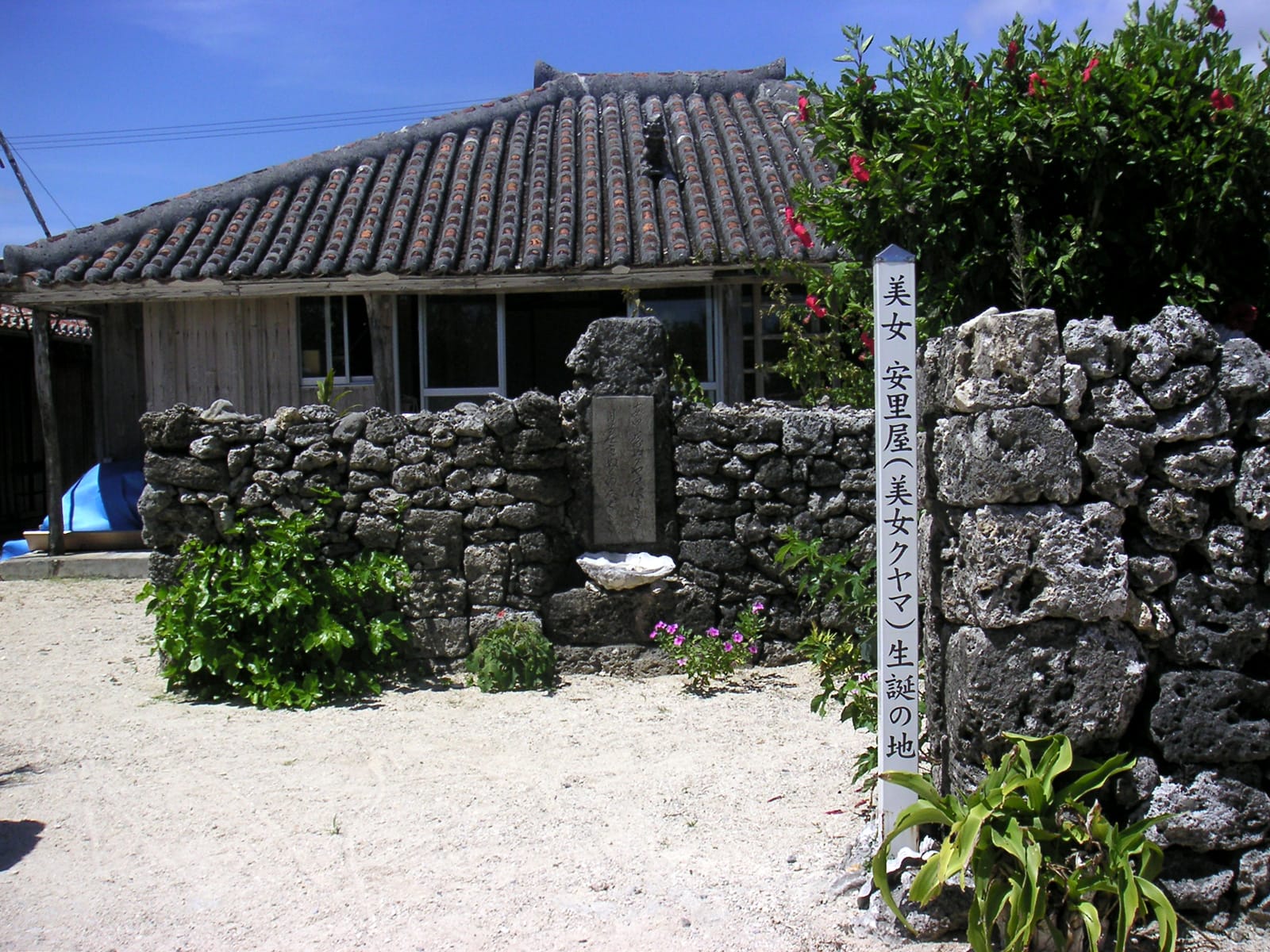
A red-tiled house with a coral stone wall
Photo: Paipateroma / CC BY 3.0 · Original · Resized and croppedHistoric districts
Taketomi Island, Taketomi
竹富町竹富島 (たけとみちょうたけとみじま)
A village on a small Yaeyama island where red-tiled houses sit behind coral-stone walls called gukku along white sand lanes. Under the Taketomi Island Charter drawn up by the islanders, the lanes are swept every morning and the island's way of life and scenery are carefully protected.
Key facts
- Designation
- Important Preservation Districts for Groups of Traditional Buildings
- Type
- Historic districts
- Location
- Taketomi, Okinawa
- Address
- 沖縄県八重山郡竹富町
Before you go
- Opening hours
- Check the official site
- Closed
- Check the official site
- Admission (adults)
- The island asks visitors for an entry fee (¥300) that supports its natural environment, village landscape and traditional culture.
- Time needed
- Check the official site
- Getting there
- High-speed ferries from Ishigaki Port Ritou Terminal reach Taketomi Port in 10 to 15 minutes. The village is about a 15-minute walk from the port, and buses also run there. There are no rental cars on the island, so get around on foot, by rental bicycle or by bus.
- Best time to visit
- Tanadui, a nationally designated Important Intangible Folk Cultural Property, is held each autumn, with performing arts offered at Yumuchi Utaki on the 7th and 8th days. The dates follow the traditional zodiac calendar and change every year (in recent years, November).
- Good to know
- Do not walk around in swimwear or shirtless anywhere except the beach. Utaki (sacred sites) must not be entered, and visitors are asked not to peer into private yards or fly drones. Take your trash home with you.
Checked against official information on November 12, 2026. Fees and hours can change, so please also check the official site before you go.
Sources for visitor information
Key facts
- Designation
- Important Preservation Districts for Groups of Traditional Buildings
- Type
- Historic districts
- Location
- Taketomi, Okinawa
- Address
- 沖縄県八重山郡竹富町
About this place
Taketomi Island is a preservation district for an island farming village on a small island in Yaeyama District, Okinawa Prefecture, covering about 38.3 hectares. It consists of three settlements in the center of the island, where houses with red-tile roofs, built as separate detached buildings, stand within compounds enclosed by white-sand roads, stone walls called guku, and house forests. It was selected as an Important Preservation District for Groups of Traditional Buildings in 1987. The island receives over 400,000 visitors a year, and water-buffalo cart tours go around the settlement.
Knowing how a compound is organized makes it easier to picture what lies behind the stone walls. Each compound is enclosed by a wall (guku) of coral-reef stones, and the main house, the fuya, which serves as both living room and bedroom, stands at the center of the plot. To its west is the tora, where cooking is done. The buildings are single-story wooden structures in the nuki style. Their hip roofs are either red Ryukyu tile finished with plaster or thatch, the outer walls use wooden boards and wooden shutters, and the eaves are low and deep.
The town names the Former Yonaguni Residence, an Important Cultural Property, as the traditional house that symbolizes the island. It was designated in 2007, and a conservation and utilization plan was drawn up in fiscal 2017. The town aims to use the house not only to convey the form of the traditional house but also as a place for residents to meet and learn, and as a tourist resource. The island also has the Tanedori festival, a nationally designated Important Intangible Folk Cultural Property, and the West Pier, a registered tangible cultural property.
The townscape is held together by the residents' own rules. In 1986 the Taketomi community center adopted the Taketomi Island Charter, whose basic principles are five: do not sell, do not soil, do not disturb, do not destroy, and make use. The town's preservation ordinance was enacted the same year, and national selection followed the next year. In 2015 the general meeting resolved never to accept resort development again. The Townscape Coordination Committee meets once a month and discusses each application for alteration one by one.
The challenges are stated plainly. The island has no mountains, and building materials were traditionally brought from Iriomote Island, but logging is now prohibited in Iriomote's mountains, so traditional timber is hard to obtain. Repairs use salvaged timber from old houses demolished on Ishigaki Island. Few carpenters can build a traditional house, so handing down the skills is an issue. Nearly 80 percent of the 109 preserved properties have finished repairs. Because residents sweep the white-sand roads every morning, keep in mind as you walk that this is where they live.
About the district
- Type of district
- island farming village
- Area
- 38.3 hectares
- Selected
- April 28, 1987
Sources and date checked
Facts such as eras, structures and locations are edited and translated by us from the Agency for Cultural Affairs’ database of nationally designated cultural properties. The Agency and the national government did not produce this page.
Database of nationally designated cultural properties- Agency for Cultural Affairs, Database of National Cultural Properties
- Taketomi Town Taketomi Island (prepared by Taketomi Town, published by Agency for Cultural Affairs)
Checked on November 6, 2026
Report an error
If you notice a mistake, please tell us along with a source for the correct information.
Where to go next
Places you could see on the same day, and places worth comparing.
More from Okinawa
Discover more of the same region on our sister sites.
GI Zukan
GI products of Okinawa
- Ryukyu Moromisu
- Gushichan Piman (Green Pepper)
- Nakagusuku Shima Ninjin (Island Carrot)
- Chinsuko (Okinawan Shortbread)
Meiga no Furusato
Paintings linked to Okinawa
- Eight Views of the Ryukyu Islands: Autumn Sky at Choko
- Eight Views of the Ryukyu Islands: Evening Moon at Izumizaki
- Eight Views of the Ryukyu Islands: The Sacred Spring at Jogaku
- Pheasants in the Snow
Sake Tabi
Breweries and distilleries in Okinawa
- Helios Distillery
- Orion Happy Park (Orion Beer Nago Brewery)
- Seifuku Distillery
- Taragawa Cave Storage Tour